 뒤로
General Biology: Key Concepts from Cell Biology to Genetics
 02:17

이 집합의 용어 (28)
Energy is the ability to do work or cause change.
Entropy measures how spread out energy is; disorder tends to increase in energy transfers.
A calorie is the energy needed to raise 1 gram of water by 1°C; a food Calorie equals 1,000 calories.
An enzyme is a biological catalyst, usually a protein, that speeds a reaction without being consumed.
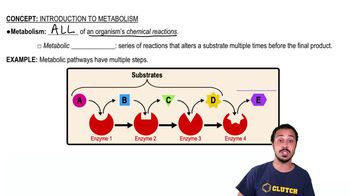
Metabolism includes all chemical reactions in an organism.
Activation energy is the energy needed to start a chemical reaction.
ATP (adenosine triphosphate) is a short-term energy carrier; losing its terminal phosphate releases energy to power cellular work.
Energy from food or sunlight rebuilds ATP from ADP + phosphate; cells use ATP, releasing phosphate and making ADP again.
Competitive inhibition blocks the active site; noncompetitive inhibition binds elsewhere changing enzyme shape. Both slow reactions but differ in binding and reversibility.
Hypertonic: more solute outside, water leaves cell.
Hypotonic: less solute outside, water enters cell.
Isotonic: equal solute, no net water movement.
Passive transport moves substances down gradients without energy; active transport requires energy to move substances against gradients.
Glucose + 6 O₂ → 6 CO₂ + 6 H₂O + usable energy (ATP and heat).
Inputs: light, CO₂, H₂O.
Outputs: O₂ and sugars (G3P/glucose).
Chloroplast has outer and inner membranes, stroma (fluid), thylakoids (membrane sacs), grana (stacks), and lumen (thylakoid interior).
Produce O₂, ATP, NADPH in thylakoid membranes.
Produces G3P (sugar precursor), ADP + phosphate, NADP⁺ in the stroma.
Prophase: chromosomes condense, spindle forms.
Prometaphase: nuclear envelope breaks down.
Metaphase: chromosomes align.
Anaphase: sister chromatids separate.
Telophase: nuclei reform.
Mitosis: one division, two diploid identical cells.
Meiosis: two divisions, four haploid genetically varied cells.
DNA is a double helix with antiparallel strands; bases pair A–T and C–G.
RNA polymerase binds promoter, elongates RNA 5′→3′, and terminates at stop sequence.
Ribosome reads mRNA from start codon AUG; tRNAs bring amino acids matching codons; peptide bonds form; stops at stop codon.
Without lactose, repressor binds operator blocking transcription; lactose inactivates repressor; low glucose activates CAP–cAMP to boost transcription.
Two alleles separate during gamete formation; each gamete gets one allele.
Heterozygotes have an intermediate phenotype distinct from either homozygote.
Linked genes are close on the same chromosome and tend to be inherited together.
Unlinked genes assort independently.
Substitution: silent, missense, nonsense.
Insertion/deletion: can cause frameshift altering many codons.
Lytic: rapid virus production and host cell lysis.
Lysogenic: viral DNA integrates into host genome, can later enter lytic cycle.
Embryonic stem cells: pluripotent, from early embryo.
Adult stem cells: multipotent, from developed tissues.