 뒤로
General Biology: Key Concepts in Fungi, Animal Diversity, Invertebrates, and Vertebrates

 08:59

이 집합의 용어 (24)
Fungi are heterotrophic, use absorptive nutrition, are sessile, usually multicellular, have cell walls made of chitin, and have bodies made of mycelium.
Fungi belong to Opisthokonta and share characteristics with animals, such as heterotrophy and certain molecular features.
Fungi life cycle includes haploid stages (spores and hyphae), a dikaryotic stage (two nuclei per cell), and a short diploid stage during sexual reproduction.
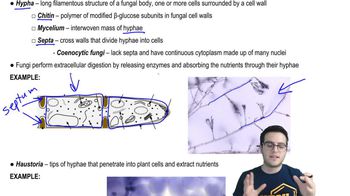
Fungi bodies consist of hyphae forming a mycelium. Growth occurs at hyphal tips, and reproductive structures produce spores.
Fungi act as decomposers, form mycorrhizal associations with plants, act as pathogens, form lichens with algae, and have biotechnological applications.
Fungi grow by extending hyphal tips through localized cell wall synthesis and cytoplasmic expansion.
Hyphae are threadlike filaments; a mycelium is a network of hyphae forming the fungal body.
Animals are heterotrophic, multicellular, lack cell walls, usually have nerves and muscles, and can move.
The Cambrian Period saw rapid animal diversification due to new ecological niches and evolutionary innovations.
Bilateral symmetry allows directional movement and more complex nervous systems for active lifestyles.
Diploblastic animals have two germ layers (ectoderm and endoderm); triploblastic have three (ectoderm, mesoderm, endoderm).
Animals reproduce sexually with a gametic life cycle where the diploid stage dominates and gametes are haploid.
Protostomes develop the mouth from the blastopore; deuterostomes develop the anus from the blastopore.
Tissue: group of similar cells; bilateral symmetry: one plane divides body into mirror halves; radial symmetry: multiple planes.
Includes Porifera, Cnidaria, Platyhelminthes, Mollusca, Annelida, Nematoda, Arthropoda, Echinodermata, and Chordata.
Exoskeleton provides protection and support but requires molting for growth.
In echinoderms, the water vascular system aids in locomotion, feeding, and gas exchange using tube feet.
Chordates have a notochord, dorsal hollow nerve cord, pharyngeal slits, post-anal tail, and endostyle.
Vertebrates evolved vertebral columns, jaws, endoskeletons, lungs, limbs, amniotic eggs, and hair.
Tetrapods developed limbs, stronger skeletons, and lungs to transition to terrestrial life.
Amniotes have amniotic eggs, internal fertilization, desiccation-resistant skin, and thoracic breathing.
Mammals include monotremes (egg-laying), marsupials (pouched), and eutherians (placental).
Primates have grasping hands, forward-facing eyes, and large brains; groups include monkeys, apes, and humans.
Humans evolved bipedalism, larger brains, and tool use; genus Homo originated in Africa with overlapping species.