Skip to main content
General Biology
나의 코스
배우기
시험 준비
AI 튜터
학습 가이드
교과서적 해결책
플래시카드
탐험해 보세요
앱을 사용해 보세요
나의 코스
배우기
시험 준비
AI 튜터
학습 가이드
교과서적 해결책
플래시카드
탐험해 보세요
앱을 사용해 보세요
뒤로
General Biology Lab Exam 1 Study Guide
카드를 뒤집기 위해 탭할 수 있습니다.
What are the basic lab safety rules?
카드를 뒤집기 위해 탭할 수 있습니다.
👆
What are the basic lab safety rules?
Use proper PPE, follow disposal procedures, and maintain cleaning procedures to ensure safety.
진행 상황 추적
컨트롤 버튼이 '내비게이션' 모드로 변경되었습니다.
1/19
추천 영상
01:35
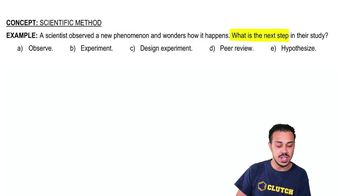
Scientific Method Example 1
13307
views
300
rank
03:03
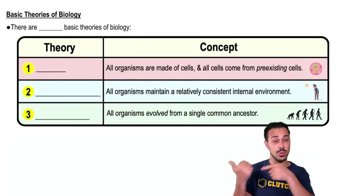
Basic Theories of Biology
14105
views
290
rank
1
comments
06:29
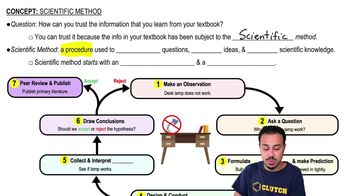
Scientific Method
22338
views
532
rank
1
comments
이 집합의 용어 (19)
하이드의 정의
What are the basic lab safety rules?
Use proper PPE, follow disposal procedures, and maintain cleaning procedures to ensure safety.
What does PPE stand for and why is it important?
PPE
stands for Personal Protective Equipment; it protects you from hazards in the lab.
What are proper disposal procedures in the lab?
Dispose of chemicals and biological materials according to lab guidelines to prevent contamination and accidents.
What are cleaning procedures in the lab?
Clean work surfaces and equipment after use to maintain a safe and contamination-free environment.
Define technology in the context of science.
Technology
is the application of scientific knowledge for practical purposes.
What is deductive science?
Deductive science
uses general principles to predict specific outcomes.
What is inductive science?
Inductive science
involves making generalizations based on specific observations.
What is pure science?
Pure science
is the pursuit of knowledge for its own sake without immediate practical application.
List the steps of the scientific method in order.
Observation, Question, Hypothesis, Experiment, Data Collection, Analysis, Conclusion.
What is the difference between a theory and a hypothesis?
A
hypothesis
is a testable prediction; a
theory
is a well-supported explanation based on evidence.
What is the boiling point of water?
The boiling point of water is \(100^{\circ}C\) at standard atmospheric pressure.
How many milligrams are in a gram?
There are 1000 milligrams in 1 gram.
Name the main parts of a microscope.
Eyepiece, objective lenses, stage, light source, coarse and fine focus knobs, arm, base.
What is the function of the eyepiece on a microscope?
The eyepiece magnifies the image formed by the objective lens.
What are macromolecules?
Macromolecules
are large molecules essential for life, including carbohydrates, lipids, proteins, and nucleic acids.
What substances do carbohydrates make up?
Carbohydrates are made of carbon, hydrogen, and oxygen and provide energy and structural support.
What are lipids composed of and their function?
Lipids are made mostly of carbon and hydrogen and store energy, form membranes, and act as signaling molecules.
What are proteins made of and their role?
Proteins are made of amino acids and perform structural, enzymatic, and regulatory functions.
What are nucleic acids and their function?
Nucleic acids like DNA and RNA store and transmit genetic information.
 뒤로뒤로
 01:35