뒤로

General Biology Lab Practical Review
컨트롤 버튼이 '내비게이션' 모드로 변경되었습니다.
1/45
  • What is plasmolysis?

    Plasmolysis is the shrinking of a plant cell due to water loss when placed in a hypertonic solution.

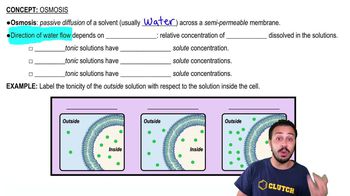
  • What does it mean if a cell is isotonic to its surroundings?

    The concentration of solutes inside and outside the cell is equal, so there is no net movement of water.

  • Define osmosis.

    Osmosis is the diffusion of water across a semipermeable membrane.

  • What happens to a plasmolyzed plant cell placed in distilled water?

    The cell will gain water and swell; it will not lose water.

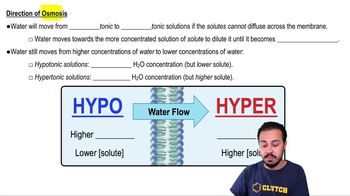
  • What happens to red blood cells in distilled water?

    They will lyse (burst) because distilled water is hypotonic to the cells.

  • Which function is NOT performed by the smooth endoplasmic reticulum?

    Protein synthesis is not a function of smooth ER; it is done by rough ER.

  • What part of phospholipids is hydrophobic?

    The fatty acid tails are hydrophobic.

  • What is the main function of the nucleus?

    It houses the cell's hereditary information (DNA).

  • What characterizes rough endoplasmic reticulum?

    Presence of ribosomes attached to its membrane.

  • What is the role of lysosomes?

    They are involved in intracellular digestion.

  • What type of cell lacks a nuclear membrane and membrane-bound organelles?

    Prokaryotic cells lack these structures.

  • What is the semifluid medium inside a cell called?

    The semifluid medium is called the cytosol.

  • Which organelle is found in both prokaryotic and eukaryotic cells?

    Ribosomes are present in both cell types.

  • Which cells have a cell wall?

    Plant cells have a cell wall.

  • During osmosis, what moves through the membrane?

    Only water moves through the membrane.

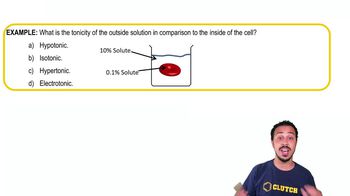
  • What happens to a cell with 10% solute concentration placed in 0% solute solution?

    The cell will gain water due to osmosis.

  • If solution A is isotonic to solution B, what is the tonicity of solution B relative to A?

    Solution B is also isotonic to solution A.

  • What happens to a plant cell placed in a hypertonic solution?

    The plant cell will lose water and undergo plasmolysis.

  • Compare cellular respiration and fermentation.

    Cellular respiration is aerobic, while fermentation is anaerobic.

  • Where does the substrate bind on an enzyme?

    The substrate binds to the enzyme's active site.

  • Which microscope is best for viewing live fruit flies?

    A dissecting light microscope is best suited for this purpose.

  • What is the total magnification using a 40X objective lens with a 10X eyepiece?

    Total magnification is \(400X\).

  • What are the magnifications of scanning, low, and high power lenses?

    Scanning: 4X, Low: 10X, High: 40X.

  • List two major differences between prokaryotic and eukaryotic cells.

    Prokaryotic cells are smaller and lack a nucleus; eukaryotic cells are larger with membrane-bound organelles and a nucleus.

  • What dye is used to stain cheek epithelial cells?

    Methylene blue is used for staining cheek cells.

  • Name two features that distinguish plant cells from animal cells.

    Plant cells have a cell wall and chloroplasts.

  • What are the inputs and outputs of cellular respiration?

    Inputs: glucose and O2; Outputs: CO2, water, and ATP.

  • What gas does soda lime absorb in cellular respiration experiments?

    Soda lime absorbs CO2.

  • Match the organelle to its function: Mitochondria.

    Mitochondria generate energy and are known as the "powerhouse of the cell."

  • What happens to red blood cells in a hypertonic solution?

    They undergo crenation (shrinking).

  • What organic molecule are enzymes composed of?

    Enzymes are composed of proteins.

  • How does a change in pH affect enzyme function?

    It can change the enzyme's shape, preventing substrate binding and reducing enzyme activity.

  • What happens to enzymes at high temperatures?

    They denature and lose function.

  • What is the optimum temperature for most human enzymes?

    About \(40^{\circ}C\).

  • What is the first step of the scientific method?

    Making an observation.

  • What is the difference between an observation and an inference?

    An observation is a direct sensory input; an inference is a conclusion drawn from observations.

  • What must a hypothesis be?

    A hypothesis must be testable and falsifiable.

  • What does 'parfocal' mean in microscopy?

    Little refocusing is needed when switching between objective lenses.

  • What is the source of illumination in electron microscopes?

    Electron microscopes use electrons as the source of illumination.

  • What is the difference between competitive and noncompetitive enzyme inhibitors?

    Competitive inhibitors bind to the active site, noncompetitive do not.

  • Which indicator test detects proteins and what color does it turn?

    The Biuret test detects proteins and turns violet or purple.

  • What effect does increased atmospheric CO2 have on ocean pH?

    It causes a decrease in oceanic pH (acidification).

  • How many valence electrons does carbon have?

    Carbon has \(4\) valence electrons.

  • How many bonds does nitrogen typically form?

    Nitrogen typically forms \(3\) bonds.

  • How many neutrons does oxygen have if its mass number is 16 and atomic number is 8?

    Oxygen has \(8\) neutrons.