 뒤로
General Biology: Life and Energy
 04:21

이 집합의 용어 (17)
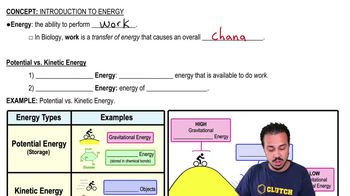
Energy is the capacity to do work. Potential energy is stored energy, while kinetic energy is energy of motion. Potential energy can be converted into kinetic energy and vice versa.
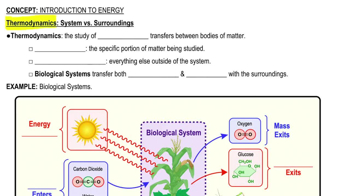
The first law of thermodynamics states that energy is neither created nor destroyed, only transformed from one form to another.
The second law of thermodynamics states that energy transformations increase entropy (disorder), and some energy is lost as heat during these processes.
Plants convert solar energy into chemical energy by producing glucose through photosynthesis, storing energy in chemical bonds.
ATP stores and transfers energy within cells, providing energy for cellular processes by releasing phosphate groups.
Metabolism is all chemical reactions in living organisms, including anabolism (building molecules) and catabolism (breaking down molecules).
Exergonic reactions release energy, while endergonic reactions require energy input. They are often coupled in cells.
Energy released from exergonic reactions drives endergonic reactions, allowing cells to perform work efficiently.
Some energy is lost as heat during energy transformations, increasing entropy.
Cellular respiration includes glycolysis, the citric acid cycle, and the electron transport chain, breaking down glucose to produce ATP.
Aerobic respiration requires oxygen and produces more ATP; anaerobic respiration occurs without oxygen, producing less ATP and byproducts like lactic acid or alcohol.
Alcohol fermentation produces ethanol and CO2; lactic acid fermentation produces lactic acid, both regenerating NAD+ for glycolysis.
Photosynthesis uses endergonic reactions to convert light energy into chemical energy, producing glucose from CO2 and H2O.
Light reactions capture light energy to produce ATP and NADPH; dark reactions (Calvin Cycle) use these to synthesize glucose.
The Calvin Cycle uses ATP and NADPH to fix CO2 into glucose during the dark reactions.
NAD+ and NADP+ are electron carriers; NADH and NADPH carry electrons to help produce ATP and synthesize molecules.
ADP is converted to ATP by adding a phosphate group, storing energy for cellular use.