Skip to main content
General Biology
나의 코스
배우기
시험 준비
AI 튜터
학습 가이드
교과서적 해결책
플래시카드
탐험해 보세요
앱을 사용해 보세요
나의 코스
배우기
시험 준비
AI 튜터
학습 가이드
교과서적 해결책
플래시카드
탐험해 보세요
앱을 사용해 보세요
뒤로
General Biology: Macromolecules and Biomolecules lab 4
카드를 뒤집기 위해 탭할 수 있습니다.
What elements primarily compose organic compounds in living organisms?
카드를 뒤집기 위해 탭할 수 있습니다.
👆
What elements primarily compose organic compounds in living organisms?
Carbon (C), Hydrogen (H), Oxygen (O), Nitrogen (N), Phosphorus (P), and Sulfur (S)
.
진행 상황 추적
컨트롤 버튼이 '내비게이션' 모드로 변경되었습니다.
1/24
추천 영상
01:17
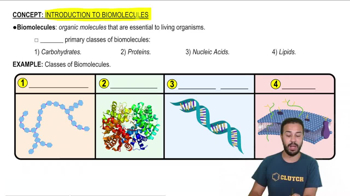
Introduction to Biomolecules
30782
views
661
rank
4
comments
01:29
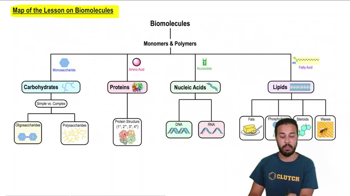
Map of the Lesson on Biomolecules
25227
views
830
rank
이 집합의 용어 (24)
하이드의 정의
What elements primarily compose organic compounds in living organisms?
Carbon (C), Hydrogen (H), Oxygen (O), Nitrogen (N), Phosphorus (P), and Sulfur (S)
.
What are the four main classes of organic macromolecules?
Carbohydrates, lipids, proteins, and nucleic acids.
What is a polymer and which macromolecules are polymers?
Polymers
are large molecules made of repeating monomers.
Carbohydrates, proteins, and nucleic acids
are polymers.
What are the monomers of carbohydrates, proteins, and nucleic acids?
Monosaccharides for carbohydrates, amino acids for proteins, and nucleotides for nucleic acids.
What distinguishes lipids from other macromolecules?
Lipids are
hydrophobic
and generally lack polar groups, often containing fatty acids and phosphate groups.
What is the general formula characteristic of carbohydrates?
Carbohydrates have a hydrogen to oxygen ratio of approximately
2:1
, e.g., glucose (C6H12O6).
What are monosaccharides, disaccharides, and polysaccharides?
Monosaccharides are single sugar units; disaccharides are two monosaccharides linked; polysaccharides are long chains of monosaccharides.
What is the covalent bond called that links monosaccharides in disaccharides like sucrose?
A
glycosidic bond
.
What is the difference between starch and cellulose polysaccharides?
They differ in the type of glucose linkage; starch is for energy storage, cellulose provides structural support.
What is Benedict's test used for?
Detecting the presence of
simple sugars
like monosaccharides and some disaccharides by color change upon heating.
Why are lipids insoluble in water?
Because they lack polar groups and are
non-polar
, making them hydrophobic.
What structural difference distinguishes saturated from unsaturated lipids?
Saturated lipids have
no double bonds
in fatty acid chains; unsaturated lipids have one or more double bonds.
What are the main components of a triglyceride?
One glycerol molecule and three fatty acid chains.
How do phospholipids differ structurally from triglycerides?
Phospholipids have two fatty acids and a phosphate group attached to glycerol, making them amphipathic.
What does amphipathic mean in phospholipids?
Having both a hydrophilic (polar phosphate head) and hydrophobic (non-polar fatty acid tails) region.
What structural feature is characteristic of steroids?
Four fused carbon rings.
Why are steroids and triglycerides both classified as lipids despite structural differences?
Both are
hydrophobic
and insoluble in water.
What is the functional group that Biuret reagent reacts with in proteins?
The
N-H bond
in the amino group of peptide bonds.
What causes protein denaturation?
Disruption of secondary, tertiary, or quaternary structures by heat, pH changes, solvents, or vibration.
What are the three parts of a nucleotide?
A pentose sugar, a phosphate group, and a nitrogenous base.
What is the difference between ribose and deoxyribose sugars?
Deoxyribose lacks one oxygen atom at the 2' carbon compared to ribose.
What are purines and pyrimidines?
Purines have a double-ring structure (adenine, guanine); pyrimidines have a single-ring (thymine, cytosine, uracil).
How do nitrogenous bases pair in DNA?
Adenine pairs with thymine; guanine pairs with cytosine via hydrogen bonds.
What does it mean that DNA strands are antiparallel?
The two strands run in opposite directions: one 5' to 3', the other 3' to 5'.
 뒤로뒤로
 01:17