Skip to main content
General Biology
나의 코스
배우기
시험 준비
AI 튜터
학습 가이드
교과서적 해결책
플래시카드
탐험해 보세요
앱을 사용해 보세요
나의 코스
배우기
시험 준비
AI 튜터
학습 가이드
교과서적 해결책
플래시카드
탐험해 보세요
앱을 사용해 보세요
뒤로
General Biology: Macromolecules and Their Functions
카드를 뒤집기 위해 탭할 수 있습니다.
What are the four categories of biological macromolecules?
카드를 뒤집기 위해 탭할 수 있습니다.
👆
What are the four categories of biological macromolecules?
Carbohydrates
,
Proteins
,
Lipids
, and
Nucleic acids
.
진행 상황 추적
컨트롤 버튼이 '내비게이션' 모드로 변경되었습니다.
1/27
추천 영상
01:17
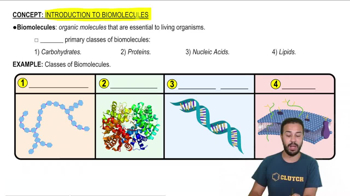
Introduction to Biomolecules
30459
views
660
rank
4
comments
01:29
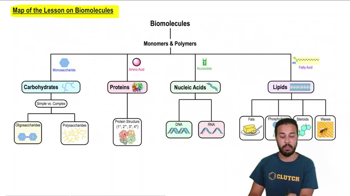
Map of the Lesson on Biomolecules
24984
views
828
rank
이 집합의 용어 (27)
하이드의 정의
What are the four categories of biological macromolecules?
Carbohydrates
,
Proteins
,
Lipids
, and
Nucleic acids
.
Define monomer and polymer in biological macromolecules.
A
monomer
is a single building block molecule; a
polymer
is many monomers covalently bonded together.
What is dehydration synthesis?
A reaction that covalently bonds monomers together by removing a water molecule.
What is hydrolysis?
A reaction that breaks polymers into monomers by adding a water molecule.
What defines organic compounds in biology?
Compounds that contain carbon, except carbon dioxide which is inorganic.
What is the monomer of carbohydrates?
A
monosaccharide
.
What is the chemical ratio of elements in carbohydrates?
Carbohydrates are made of carbon, hydrogen, and oxygen in a
1:2:1
ratio.
Name three polysaccharides and their functions.
Starch
stores energy in plants,
glycogen
stores energy in animals,
cellulose
provides plant cell wall structure.
What are lipids and their general property regarding water?
Lipids are large molecules that are
hydrophobic
(water-fearing) and do not mix with water.
Describe the structure of triglycerides.
A glycerol molecule covalently bonded to three fatty acids via dehydration synthesis.
Difference between saturated and unsaturated fats?
Saturated fats have only single bonds and are solid at room temperature; unsaturated fats have one or more double bonds causing bends and are liquid.
What are trans fats?
Artificially made fats where double bonds are broken and hydrogens added, making them unhealthy saturated fats.
Describe the structure and function of phospholipids.
Phospholipids have a glycerol, two fatty acids (hydrophobic tails), and a phosphate head (hydrophilic); they form cell membranes as bilayers.
What are steroids and their structure?
Hydrophobic lipids made of four fused carbon rings, including cholesterol and hormones.
What is the monomer of proteins?
An
amino acid
.
What groups are bonded to the central carbon in an amino acid?
A hydrogen, an amino group (-NH3), a carboxyl group (-COOH), and a variable side chain (R group).
What determines a protein's structure and function?
The
3D folding
of the protein, which is determined by amino acid sequence and interactions.
List the four levels of protein structure.
Primary (amino acid sequence), secondary (alpha helix or beta sheet), tertiary (3D folding), quaternary (multiple subunits).
What causes protein denaturation?
Heat, salt concentration changes, and strong acids or bases can cause loss of shape and function.
What are the two types of nucleic acids?
DNA
(deoxyribonucleic acid) and
RNA
(ribonucleic acid).
What is the monomer of nucleic acids?
A
nucleotide
, composed of sugar, phosphate, and nitrogenous base.
Name the nitrogenous bases in DNA and RNA.
DNA: adenine, thymine, cytosine, guanine; RNA: adenine, uracil, cytosine, guanine.
What is the shape of DNA?
A
double helix
.
What is the base pairing rule in DNA?
A pairs with T, and G pairs with C.
What is the base pairing rule between DNA and RNA?
DNA adenine pairs with RNA uracil; DNA guanine pairs with RNA cytosine.
What is the function of DNA?
Stores genetic information and instructions for making proteins.
How are the DNA backbone strands held together?
By covalent bonds between the sugar of one nucleotide and the phosphate of the next.
 뒤로뒤로
 01:17