 뒤로
General Biology: Membrane Transport and Cell Signaling
 02:21

이 집합의 용어 (39)
The movement of substances across a cell membrane, including passive and active mechanisms.
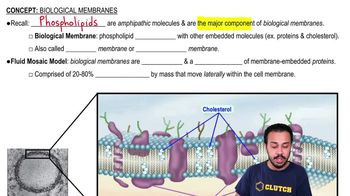
Amphipathic molecules forming the bilayer of membranes, with hydrophilic heads and hydrophobic tails.
Model describing the membrane as a fluid combination of lipids, proteins, and carbohydrates.
The membrane's ability to allow some substances to pass while blocking others.
The maintenance of stable internal conditions within a cell or organism.
A gradient of electrical charge and chemical concentration across a membrane that drives ion movement.
Molecules having both hydrophilic and hydrophobic regions, like phospholipids.
Saturated fatty acids have no double bonds; unsaturated have one or more, affecting membrane fluidity.
A lipid that stabilizes membrane fluidity by preventing tight packing of phospholipids.
Proteins embedded in the membrane that assist in transport, signaling, and structural support.
Transport, enzymatic activity, signal transduction, cell recognition, intercellular joining, and attachment.
Membrane carbohydrates covalently bonded to proteins or lipids, important for cell recognition.
A difference in concentration or charge that drives diffusion or transport across membranes.
Diffusion of water across a selectively permeable membrane from low to high solute concentration.
The control of water balance within a cell or organism to maintain homeostasis.
Hypertonic solutions cause cells to lose water; hypotonic solutions cause cells to gain water.
Passive movement of molecules from high to low concentration without energy input.
Passive transport requires no energy; active transport uses energy to move substances against gradients.
Proteins that facilitate selective transport of ions and molecules across membranes.
Membrane proteins that generate voltage across membranes by moving ions, e.g., sodium-potassium pump.
Active transport pump that moves 3 Na+ out and 2 K+ into the cell, maintaining membrane potential.
Active transporter that moves H+ ions across membranes, creating a proton gradient.
The voltage difference across a membrane due to ion distribution.
Uniporter moves one substance; symporter moves two in same direction; antiporter moves two in opposite directions.
Processes that move large molecules or particles into (endocytosis) or out of (exocytosis) the cell.
Phagocytosis engulfs large particles; pinocytosis ingests extracellular fluid and solutes.
Intercellular signaling occurs between cells; intracellular signaling occurs within a cell.
Cells respond to signals they themselves release.
Signals affect nearby target cells.
Neurons release neurotransmitters to signal adjacent cells across synapses.
Hormones travel through the bloodstream to distant target cells.
The process by which a signal is converted into a cellular response.
Ligands are signaling molecules that bind to specific receptors to initiate signaling.
Membrane receptors that activate G proteins to relay signals inside the cell.
Receptors located inside the cell that bind hydrophobic ligands like steroid hormones.
Process where a small signal triggers a large cellular response through cascades.
Phosphorylation adds phosphate groups via kinases; phosphatases remove them, regulating protein activity.
Small molecules like cyclic AMP that relay and amplify signals inside the cell.
A common second messenger that activates protein kinase A to regulate cellular processes.