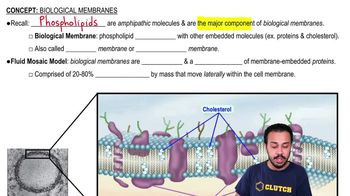
Describes the membrane as a flexible phospholipid bilayer with various proteins embedded or attached.
Phospholipid amphipathic nature
Phospholipids have hydrophilic heads facing water and hydrophobic tails pointing inward, away from water.
Integral vs peripheral proteins
Integral proteins are embedded in the bilayer; peripheral proteins attach to the membrane surface.
Six major membrane protein functions
Transport, enzymatic activity, signal transduction, cell-cell recognition, intercellular joining, attachment to cytoskeleton/ECM.
Membrane fluidity factors
Affected by temperature, cholesterol, and tail saturation; unsaturated tails increase fluidity, cholesterol buffers fluidity.
Selective permeability
Membrane allows some substances to cross more easily; small nonpolar molecules cross readily, ions and polar molecules do not.
Channel vs carrier proteins
Channels form hydrophilic passageways; carriers bind substances and change shape to transport them.
Osmosis
Net movement of water across a selectively permeable membrane toward higher solute concentration.
Effects of hypotonic, isotonic, and hypertonic solutions on cells
Hypotonic: water enters (animal cells may lyse, plant cells become turgid); isotonic: no net water movement; hypertonic: water leaves (animal cells shrivel, plant cells plasmolyze).
Facilitated diffusion
Passive transport using channel or carrier proteins moving substances down their concentration gradient without energy.
Active transport
Moves substances against their gradient using energy, often ATP.
Sodium–potassium pump
Uses ATP to move 3 Na⁺ out and 2 K⁺ into the cell, maintaining ion gradients and membrane potential.
Membrane potential and electrogenic pumps
Voltage difference across membrane; electrogenic pumps create voltage by moving unequal charges.
Cotransport
Uses downhill movement of one substance to drive uphill transport of another.
Bulk transport: exocytosis and endocytosis
Exocytosis releases vesicle contents outside; endocytosis encloses material in vesicles to bring into the cell.
 뒤로
 02:21