Skip to main content
General Biology
나의 코스
배우기
시험 준비
AI 튜터
학습 가이드
교과서적 해결책
플래시카드
탐험해 보세요
앱을 사용해 보세요
나의 코스
배우기
시험 준비
AI 튜터
학습 가이드
교과서적 해결책
플래시카드
탐험해 보세요
앱을 사용해 보세요
뒤로
General Biology: Membranes, Metabolism, Respiration, Photosynthesis, and Cell Cycle
카드를 뒤집기 위해 탭할 수 있습니다.
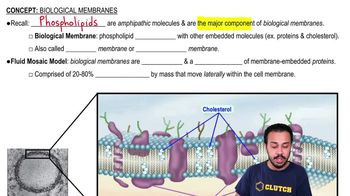
What is the plasma membrane's basic structure?
카드를 뒤집기 위해 탭할 수 있습니다.
👆
What is the plasma membrane's basic structure?
A
phospholipid bilayer
containing membrane proteins.
진행 상황 추적
컨트롤 버튼이 '내비게이션' 모드로 변경되었습니다.
1/39
추천 영상
02:21
Biological Membranes Example 1
24670
views
457
rank
1
comments
06:04
Biological Membranes
33815
views
685
rank
2
comments
이 집합의 용어 (39)
하이드의 정의
What is the plasma membrane's basic structure?
A
phospholipid bilayer
containing membrane proteins.
Which phospholipid regions are hydrophilic vs. hydrophobic?
Heads are
hydrophilic
; fatty-acid tails are
hydrophobic
.
What membrane model describes proteins within a fluid lipid bilayer?
The
fluid mosaic model
.
What does cholesterol do in an animal cell membrane?
It
buffers membrane fluidity
across temperature changes.
What is passive transport?
Movement down a gradient
without cellular energy
.
What is active transport?
Energy-driven movement
against a concentration gradient
.
What is facilitated diffusion?
Passive transport through a
membrane protein
.
What is osmosis?
Diffusion of
water
across a selectively permeable membrane.
During osmosis, water moves toward which side?
The side with the
higher solute concentration
.
What happens to an animal cell in a hypertonic solution?
It
loses water and shrivels
.
What happens to a plant cell in a hypotonic solution?
It becomes
turgid
; the cell wall prevents bursting.
What is plasmolysis?
Water loss causes the plant membrane to
pull from the cell wall
.
What are aquaporins?
Membrane channel proteins
that rapidly transport water.
What does the first law of thermodynamics state?
Energy is
conserved
; it can be transferred or transformed.
What does the second law of thermodynamics state?
Energy transformations increase the universe's
entropy
.
What does negative ΔG mean?
The reaction is
exergonic
and thermodynamically spontaneous.
What does ATP hydrolysis produce?
ADP + Pi
and released free energy.
What do enzymes lower?
Activation energy
.
Do enzymes change a reaction's ΔG?
No; they change reaction rate, not ΔG.
What is an enzyme's active site?
The region where
substrate binds and catalysis occurs
.
What is feedback inhibition?
A pathway's
end product inhibits an earlier enzyme
.
What is the first stage of cellular respiration?
Glycolysis
.
Where does glycolysis occur?
The
cytosol
.
What are glycolysis's products per glucose?
2 pyruvate, 2 NADH, and net 2 ATP.
Where does the citric acid cycle occur in eukaryotes?
The
mitochondrial matrix
.
What is aerobic respiration's final electron acceptor?
Oxygen (O2)
.
What directly powers ATP synthase?
H+
flowing down its electrochemical gradient.
What is chemiosmosis?
Using an
H+ gradient
to drive ATP synthesis.
Where do photosynthesis's light reactions occur?
The
thylakoid membranes
.
Where does the Calvin cycle occur?
The
chloroplast stroma
.
What does rubisco catalyze?
Attachment of
CO2 to RuBP
.
What is photorespiration?
Rubisco uses
O2 instead of CO2
, wasting energy.
What phase follows G1?
S phase
.
What occurs during S phase?
DNA replication
.
What happens during metaphase?
Chromosomes
align at the metaphase plate
.
What is the mitotic spindle's primary role?
Separating duplicated chromosomes
.
How does animal-cell cytokinesis occur?
A
cleavage furrow
pinches the cell in two.
What two components form active MPF?
Cyclin and Cdk
.
What feature is shared by all cancers?
Escape from
normal cell-cycle controls
.
 뒤로뒤로
 02:21