 뒤로
General Biology: Organic Chemistry and Macromolecules
 03:35

이 집합의 용어 (29)
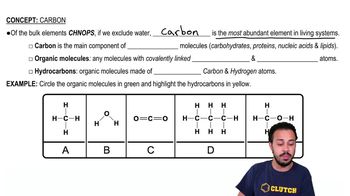
Organic compounds contain carbon and hydrogen, have covalent bonds, and are associated with living organisms. Inorganic compounds usually have ionic bonds, dissociate in water releasing ions, and are associated with nonliving matter.
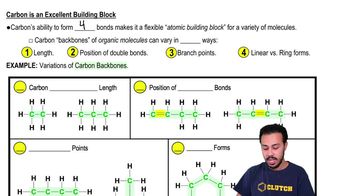
Carbon has 4 valence electrons allowing it to form 4 covalent bonds, creating diverse molecules with tetrahedral shapes and complex skeletons.
Organic molecules consisting only of carbon and hydrogen atoms, forming chains or rings, and can release large amounts of energy when broken down.
Length, branching, double bond position, and presence of rings.
Compounds with the same molecular formula but different structures and properties.
Structural isomers: different covalent arrangements.
Cis-trans isomers: differ in spatial arrangement around double bonds.
Enantiomers: mirror images of each other.
Specific groups of atoms attached to carbon skeletons that give organic molecules distinct chemical properties.
They change polarity and solubility, making molecules hydrophilic or hydrophobic, and influence chemical reactivity.
Large organic molecules made up of smaller units called monomers linked into polymers.
Monomer: small repeating unit.
Polymer: chain of monomers linked together.
A chemical reaction that removes a water molecule to form a covalent bond between monomers, synthesizing polymers and requiring energy.
A reaction that adds water to break covalent bonds between monomers, degrading polymers and releasing energy.
Serve as energy sources, energy storage, and structural components in cells.
Monosaccharides: single sugar molecules.
Disaccharides: two monosaccharides joined.
Polysaccharides: long chains of monosaccharides.
Starch: plant storage polymer of glucose.
Glycogen: animal storage polymer of glucose.
Cellulose: plant cell wall component.
Chitin: exoskeleton of arthropods and fungal cell walls.
Lipids are non-polar and hydrophobic, meaning they do not mix well with water.
Composed of glycerol and three fatty acids; function as long-term energy storage and insulation.
Saturated fats: no double bonds, solid at room temperature.
Unsaturated fats: one or more double bonds, liquid at room temperature.
Hydrogenation adds hydrogen to unsaturated fats, making them saturated and creating trans fats, which are unhealthy.
They have a hydrophilic (polar) head and two hydrophobic (nonpolar) fatty acid tails, allowing them to form bilayers in water.
Consist of four fused carbon rings; cholesterol is the precursor molecule for other steroids.
Proteins are polymers made of amino acid monomers linked by peptide bonds.
Include enzymatic catalysis, structural support, transport, communication, movement, and defense.
Primary: amino acid sequence.
Secondary: α helices and β sheets formed by hydrogen bonds.
Tertiary: 3D folding from side chain interactions.
Quaternary: multiple polypeptide chains assembled.
Changes in pH, salt concentration, temperature, or environment can unravel proteins, making them biologically inactive.
Macromolecules that store and transmit genetic information; polymers of nucleotides.
DNA is double-stranded with deoxyribose sugar and stores genetic info; RNA is single-stranded with ribose sugar and helps synthesize proteins.
Purines: adenine and guanine with two rings.
Pyrimidines: cytosine, thymine (DNA), and uracil (RNA) with one ring.