Skip to main content
General Biology
나의 코스
배우기
시험 준비
AI 튜터
학습 가이드
교과서적 해결책
플래시카드
탐험해 보세요
앱을 사용해 보세요
나의 코스
배우기
시험 준비
AI 튜터
학습 가이드
교과서적 해결책
플래시카드
탐험해 보세요
앱을 사용해 보세요
뒤로
General Biology: Organic Chemistry and Macromolecules
카드를 뒤집기 위해 탭할 수 있습니다.
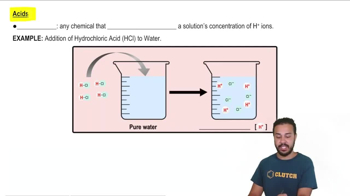
What is an acid in terms of proton transfer?
카드를 뒤집기 위해 탭할 수 있습니다.
👆
What is an acid in terms of proton transfer?
Acids
are proton (H+) donors.
진행 상황 추적
컨트롤 버튼이 '내비게이션' 모드로 변경되었습니다.
1/28
추천 영상
02:45
Acids
19508
views
279
rank
01:29
Acids and Bases
21389
views
286
rank
03:48
Bases
18646
views
249
rank
이 집합의 용어 (28)
하이드의 정의
What is an acid in terms of proton transfer?
Acids
are proton (H+) donors.
What is a base in terms of proton transfer?
Bases
are proton acceptors.
What is the role of buffers in biological systems?
Buffers minimize changes in the concentrations of H+ and OH- ions.
Why is carbon important in organic molecules?
Carbon can form
4 covalent bonds
and bond with many elements like hydrogen, oxygen, and nitrogen.
What are isomers?
Compounds with the same molecular formula but different structures and properties, including structural, cis-trans, and enantiomers.
What are functional groups?
Groups attached to carbon skeletons that participate in chemical reactions.
What are macromolecules?
Chain-like molecules called polymers made of monomers, including carbohydrates, proteins, and nucleic acids.
What is dehydration synthesis?
A chemical reaction that removes a water molecule to form a new bond between monomers.
What is hydrolysis?
A chemical reaction that adds a water molecule to break a bond in a polymer.
What are carbohydrates?
Sugars and polymers of sugars that serve as fuel and building material.
What is the general molecular formula for monosaccharides?
A multiple of \(CH_2O\), e.g., glucose and fructose (C6H12O6).
How are disaccharides formed?
By dehydration synthesis joining two monosaccharides with a glycosidic linkage.
Name two storage polysaccharides and their organisms.
Starch
in plants and
glycogen
in animals.
Name two structural polysaccharides and their organisms.
Cellulose
in plants and
chitin
in animals and fungi.
What are lipids and their key characteristic?
Lipids are hydrophobic molecules with hydrocarbon regions, not true polymers.
What is the structure of fats?
Made of glycerol and 3 fatty acids joined by ester linkages.
Difference between saturated and unsaturated fats?
Saturated fats have no double bonds; unsaturated fats have one or more double bonds.
What are phospholipids composed of?
Glycerol, 2 fatty acids, and a phosphate group; they form cell membranes.
What is the structure of steroids?
Four fused carbon rings with attached chemical groups.
What are proteins made of?
Polymers of amino acids joined by peptide bonds.
What determines the chemical nature of a protein?
The sequence and properties of the amino acid side chains (R groups).
What is the primary structure of a protein?
The unique linear sequence of amino acids in a polypeptide chain.
What are the secondary structures of proteins?
Coils and folds like α helix and β pleated sheets formed by hydrogen bonds.
What is the tertiary structure of a protein?
The overall 3D shape formed by interactions between amino acid side chains.
What is the quaternary structure of a protein?
Two or more polypeptide chains forming one functional macromolecule.
What are nucleic acids?
Polymers that store, transmit, and help express hereditary information (DNA and RNA).
What are nucleotides composed of?
A 5-carbon sugar, nitrogenous base (purines or pyrimidines), and one or more phosphate groups.
What is a phosphodiester linkage?
A covalent bond between nucleotides forming the sugar-phosphate backbone of DNA and RNA.
 뒤로뒤로
 02:45