Molecules containing carbon atoms bonded to other elements, typically hydrogen, oxygen, or nitrogen. Examples include carbohydrates, proteins, lipids, and nucleic acids.
Define hydrocarbon.
Organic molecules consisting entirely of carbon and hydrogen, forming the backbone of many organic compounds.
What is an isomer?
Molecules with the same chemical formula but different structural arrangements, resulting in different properties.
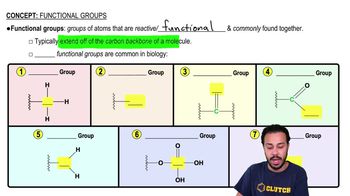
What is a functional group?
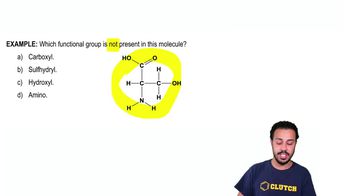
Specific groups of atoms within molecules that determine chemical reactivity and properties. Examples: hydroxyl (-OH), carboxyl (-COOH), amino (-NH2), phosphate (-PO4).
Explain polymer and monomer.
A polymer is a large molecule made of repeating units called monomers. For example, starch (polymer) is made of glucose (monomer).
What is a dehydration reaction?
A chemical reaction that joins monomers by removing a molecule of water.
What is a hydrolysis reaction?
A reaction that breaks polymers into monomers by adding water.
What are carbohydrates?
Organic molecules composed of carbon, hydrogen, and oxygen, often in a 1:2:1 ratio. Includes sugars and starches.
Define monosaccharide.
Simple sugar monomers, such as glucose and fructose.
What is a disaccharide?
Two monosaccharides joined together, e.g., sucrose (glucose + fructose).
What are polysaccharides?
Long chains of monosaccharides. Examples include starch, glycogen, and cellulose.
What is starch?
Storage polysaccharide in plants, made of glucose monomers.
What is glycogen?
Storage polysaccharide in animals, made of glucose monomers.
What is cellulose?
Structural polysaccharide in plant cell walls, made of glucose monomers.
What are lipids?
Hydrophobic organic molecules, including fats, phospholipids, and steroids.
Define fat (triglyceride).
Lipid made from glycerol and three fatty acids.
What is an unsaturated fat?
Fatty acids with one or more double bonds, causing kinks; usually liquid at room temperature.
What is a saturated fat?
Fatty acids with no double bonds; usually solid at room temperature.
What are steroids?
Lipids with four fused carbon rings; examples include cholesterol and hormones.
What is a phospholipid?
Lipid with a phosphate group; major component of cell membranes.
What are proteins?
Polymers of amino acids that perform many functions in cells.
What are amino acids?
Monomers of proteins; contain an amino group, carboxyl group, and side chain (R group).
What is denaturation?
Loss of protein structure due to environmental changes, causing loss of function.
 뒤로
 02:00