How many cotyledons do monocots and eudicots have?
Monocots have one cotyledon, eudicots have two cotyledons.
List key differences between monocots and eudicots.
Monocots: parallel veins, scattered vascular tissue, fibrous roots, pollen with 1 opening, floral organs in multiples of 3. Eudicots: netlike veins, vascular tissue in a ring, taproot, pollen with 3 openings, floral organs in multiples of 4 or 5.
Name some examples of monocots.
Orchids, lilies, grasses, palms.
Name some examples of eudicots.
Oaks, maples, roses, peas.
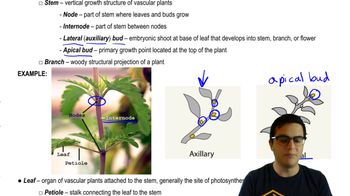
What are nodes and internodes on a stem?
Nodes are points where leaves and branches grow; internodes are the stem segments between nodes.
What is an axillary bud and an apical bud?
An axillary bud is located in the leaf axil; an apical bud is at the stem tip and is the primary growth point.
What is apical dominance?
The phenomenon where the apical bud suppresses growth of axillary buds.
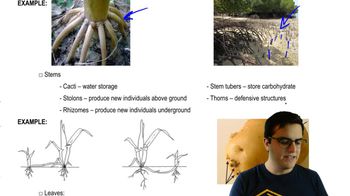
What are adventitious roots?
Roots that develop from non-root tissues such as stems or leaves.
What are root hairs and their function?
Tiny extensions of root epidermal cells that increase surface area for water and nutrient absorption.
 뒤로
 06:58