What is the plasma membrane and its primary function?
The plasma membrane is present in all cells and regulates traffic across the cell, controlling what enters and leaves.
Define simple diffusion.
Simple diffusion is the movement of solutes down their concentration gradient through the phospholipid bilayer without energy or assistance.
Define osmosis.
Osmosis is the diffusion of the solvent (water) down its concentration gradient across a selectively permeable membrane.
What do hypotonic, hypertonic, and isotonic mean?
Hypotonic: less solute; Hypertonic: more solute; Isotonic: equal solute concentration.
In osmosis, which moves first: solutes or water?
Solutes always diffuse first, then water follows to balance concentrations.
What is the difference between simple (unfacilitated) diffusion and facilitated diffusion?
Simple diffusion passes molecules through the bilayer directly; facilitated diffusion requires membrane proteins and is faster.
What factors affect the ease of molecule passage through the phospholipid bilayer?
Smaller and more hydrophobic molecules pass more easily through the bilayer.
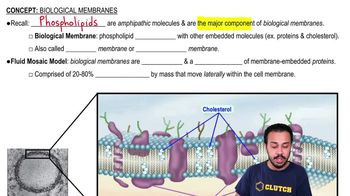
Describe the fluid mosaic model of the plasma membrane.
The membrane is fluid due to unsaturated fatty acids and mosaic due to proteins, sugars, cholesterol, and cytoskeleton asymmetrically arranged.
Why is the plasma membrane called 'sugar-coated'?
Because sugars are attached to proteins and lipids on the extracellular side, forming glycoproteins and glycolipids.
What are integral and peripheral proteins in the plasma membrane?
Integral proteins span the membrane and function in transport and signaling; peripheral proteins are hydrophilic and structural.
What is active transport and give an example?
Active transport moves substances against their concentration gradient using ATP, e.g., the Na+/K+ pump.
What is the role of the Na+/K+ pump?
It pumps 3 Na+ ions out and 2 K+ ions into the cell, consuming 1 ATP per cycle.
What distinguishes passive from active transport?
Passive transport moves substances down their concentration gradient without ATP; active transport moves substances against the gradient and requires ATP.
How does the concentration gradient affect diffusion?
Molecules move from high to low concentration in passive transport, driven by the gradient.
What happens to a cell in a hypotonic solution?
Water enters the cell, causing it to swell due to lower solute concentration outside.
What happens to a cell in a hypertonic solution?
Water leaves the cell, causing it to shrink due to higher solute concentration outside.
What is the significance of membrane asymmetry?
Different compositions on the extracellular and cytosolic sides affect membrane function and interactions.
What are glycoproteins and their function?
Proteins with attached sugars involved in cell-cell recognition and signaling.
What is facilitated diffusion's advantage over simple diffusion?
It allows molecules that cannot cross the bilayer to pass quickly via specific proteins.
How does cholesterol affect membrane fluidity?
Cholesterol modulates fluidity by preventing tight packing of fatty acids, maintaining membrane stability.
 뒤로
 02:21