 뒤로
General Biology: Prokaryotes, Eukaryotes, and Animal Diversity
 04:39

이 집합의 용어 (29)
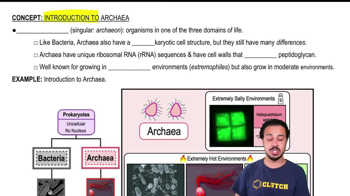
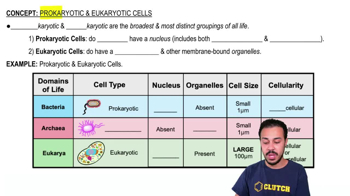
A prokaryote is a unicellular organism without a nucleus or membrane-bound organelles, including Bacteria and Archaea.
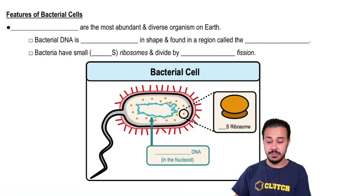
Prokaryotes have no nucleus, circular DNA, lack membrane-bound organelles, have cell walls, reproduce asexually, and are typically smaller than eukaryotic cells.
Both are prokaryotes, unicellular, lack nuclei, have circular DNA, reproduce asexually, and have similar cell sizes and shapes.
Bacteria have peptidoglycan in cell walls; Archaea have unique lipids in membranes and lack peptidoglycan. Archaea often live in extreme environments.
Metabolic pathways depend on how organisms obtain energy (light or chemicals), electrons (organic or inorganic), and carbon (organic or CO2).
Oxygenic photosynthesis evolved ~2.5 billion years ago, producing oxygen that enabled aerobic metabolism and changed Earth’s atmosphere.
Oxygen initially reacted with minerals and organic matter, delaying atmospheric accumulation despite photosynthesis.
Prokaryotes reproduce mainly by binary fission, a form of asexual reproduction producing two identical cells.
Transformation, transduction, and conjugation; these complicate phylogenies by transferring genes across lineages.
Nitrogen fixation converts atmospheric N2 into ammonia, making nitrogen available to plants for growth.
Benefits: degrade pollutants; Challenges: efficiency varies, potential toxin release, and environmental conditions affect success.
Symbiosis like gut microbiomes aiding digestion, nitrogen-fixing bacteria in plant roots, and pathogens causing disease.
Microbiomes influence digestion, immunity, and health; threats include antibiotics, diet changes, and infections.
Symptoms vary but include fever, diarrhea, respiratory issues; transmission often via contact, ingestion, or vectors.
Nucleus, membrane-bound organelles, linear chromosomes, cytoskeleton, and mitosis/meiosis; each provides cellular complexity and regulation.
The nucleus evolved from infolded plasma membrane enclosing DNA; supported by membrane continuity and nuclear pores.
Life divided into Bacteria, Archaea, and Eukarya; recent data suggest Eukarya evolved within Archaea, sister to Asgard Archaea.
Mitochondria and chloroplasts originated when a eukaryote engulfed bacteria; evidence includes double membranes and own DNA.
Increases genetic diversity, enabling adaptation and survival in changing environments.
Multicellularity is organisms composed of multiple cells; it allows specialization and larger body size, evolving multiple times in eukaryotes.
Multicellularity, heterotrophy, lack of cell walls, motility at some life stage, and specialized tissues.
Asymmetry (no symmetry), radial (symmetry around a central axis), bilateral (left-right symmetry), pentaradial (five-part radial symmetry).
A fluid-filled body cavity lined with mesoderm; distinguishes coelomates from acoelomates and pseudocoelomates.
Complete gut has two openings (mouth and anus); incomplete gut has one opening serving both functions.
Concentration of sensory organs and nervous tissue at the head; aids directional movement and processing.
HOX genes control body plan development; their evolution enabled complex body structures and diversification.
Sponges lack true tissues, have porous bodies, and use choanocytes for filter feeding; sister group to all other animals.
Move using cilia rows; catch prey with sticky cells called colloblasts, unlike cnidarians' stinging cnidocytes.
Polyp (sessile, feeding/reproductive stage) and medusa (free-swimming, sexual reproduction stage).