 뒤로
General Biology: Scientific Method and Chemistry of Life
 01:35

이 집합의 용어 (25)
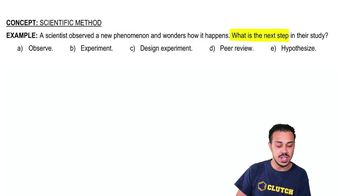
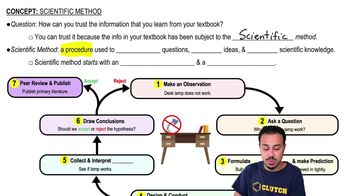
The scientific method is a process involving making observations, forming hypotheses, making predictions, testing them through experiments, and analyzing results.
A hypothesis is an explanation based on observations and assumptions that leads to a testable prediction.
Inductive reasoning forms generalizations from specific observations, while deductive reasoning uses general principles to make specific predictions.
A controlled experiment compares an experimental group with a control group, changing only the independent variable to observe effects on the dependent variable.
The independent variable is the factor changed by the experimenter; the dependent variable is the factor affected by that change.
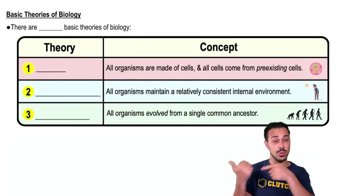
A theory is a broad explanation supported by a large body of evidence, general enough to generate many testable hypotheses.
Peer review ensures scientific results are vetted by experts, improving reliability and building on others' work.
Science informs technology, which makes life easier; society demands more science and benefits from its advances.
Elements are pure substances made of one type of atom; compounds are substances formed by two or more elements combined in fixed ratios.
Chemical properties depend on the number and arrangement of valence electrons in the outermost electron shell.
Atomic number is the number of protons; mass number is the sum of protons and neutrons in an atom.
Isotopes are atoms of the same element with different numbers of neutrons.
Covalent bonds form when atoms share pairs of electrons; they are strong and stable.
Nonpolar covalent bonds share electrons equally; polar covalent bonds share electrons unequally due to differences in electronegativity.
Ionic bonds form between positively charged cations and negatively charged anions by transferring electrons.
Hydrogen bonds are weak attractions between a hydrogen atom with a partial positive charge and an electronegative atom with a partial negative charge.
Water has partial positive and negative charges due to unequal sharing of electrons, allowing hydrogen bonding between molecules.
Water exhibits cohesion, temperature moderation, expansion upon freezing, and acts as an excellent solvent.
Cohesion is the tendency of water molecules to stick together, resulting in high surface tension.
Water's high specific heat means it absorbs a lot of heat before changing temperature, stabilizing environments for life.
When water evaporates, it removes heat from the surface, cooling the remaining liquid; important for temperature regulation in organisms.
Hydrogen bonds in ice hold molecules farther apart, making ice less dense than liquid water.
Hydrophilic substances have an affinity for water; hydrophobic substances repel water.
Acids donate H+ ions; bases accept H+ ions; water can dissociate into H+ and OH- ions.
Buffers minimize changes in H+ and OH- concentrations, maintaining stable pH in biological systems.