 뒤로
General Biology Test 2 Study Guide
 06:35

이 집합의 용어 (27)
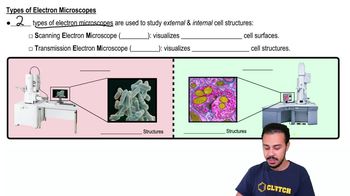
Scanning (SEM): beam of electrons onto a surface, looks 3D
Transmission (TEM): focus through a specimen
Prokaryotes lack a nucleus and membrane-bound organelles; eukaryotes have a nucleus and organelles.
Plant cells have a cell wall, chloroplasts, and large central vacuole; animal cells do not.
Free ribosomes synthesize proteins for the cytosol; bound ribosomes make proteins for membranes or secretion.
Cilia and flagella have a 9+2 microtubule arrangement; centrioles have a 9 triplet arrangement.
ECM provides structural support and mediates cell communication.
Desmosomes anchor cells; tight junctions prevent leakage; gap junctions allow communication.
Describes the membrane as a fluid bilayer of phospholipids with embedded proteins that move laterally.
Phospholipids form the bilayer; cholesterol stabilizes fluidity; proteins assist transport and signaling.
Saturated fatty acids decrease fluidity; unsaturated fatty acids increase fluidity by preventing tight packing.
Small nonpolar molecules like O2 and CO2 cross by simple diffusion.
Passive transport (no energy), active transport (energy required), and bulk transport (endocytosis/exocytosis).
Osmosis is water diffusion across a membrane toward higher solute concentration.
Isotonic: no net water movement; hypotonic: water enters cell; hypertonic: water leaves cell.
Water enters the cell, causing it to swell and possibly lyse.
Uniporters move one molecule; symporters move two molecules in the same direction; antiporters move two in opposite directions.
Uses ATP to pump 3 Na+ out and 2 K+ into the cell against their gradients.
Catabolism breaks down molecules releasing energy (exergonic); anabolism builds molecules consuming energy (endergonic).
1st: Energy cannot be created or destroyed; 2nd: Entropy of the universe increases over time.
ATP stores and transfers energy for cellular processes; without it, cells cannot perform energy-requiring functions.
Processes that occur without energy input, usually increasing entropy and decreasing free energy.
Potential: chemical bonds; kinetic: movement of molecules or heat.
Enzymes have optimal temperature and pH; deviations reduce activity or denature enzymes.
Allosteric activators increase enzyme activity; inhibitors decrease it by binding sites other than the active site.
Competitive inhibitors bind active site; noncompetitive bind elsewhere altering enzyme shape.
Activation energy is the energy barrier for reactions; enzymes lower it to speed up reactions.
Substrates are reactants enzymes act on; inhibitors reduce enzyme activity, affecting pathway flow.