 뒤로
General Biology: The Molecules of Cells
 03:35

이 집합의 용어 (26)
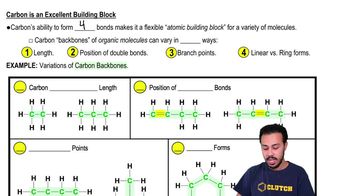
Carbon can form four covalent bonds, allowing it to build large, diverse organic compounds with various shapes and functions.
Compounds with the same molecular formula but different structures, leading to different properties.
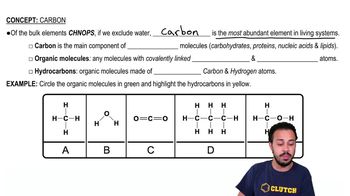
Organic molecules composed only of carbon and hydrogen, often hydrophobic and energy-rich.
The size and shape of its carbon backbone and the functional groups attached to it.
Hydroxyl, Carbonyl, Carboxyl, Amino, Phosphate, and Methyl groups.
They differ in their functional groups attached to the same carbon skeleton, affecting their biological roles.
Macromolecules are large molecules; polymers are macromolecules made of repeating monomer units.
Formed by dehydration reactions (removing water) and broken down by hydrolysis (adding water), both catalyzed by enzymes.
Simple sugar monomers with a general formula multiple of \(C_H_2O\), containing hydroxyl and carbonyl groups.
By joining two monosaccharides via a dehydration reaction, forming a glycosidic bond.
A disaccharide made of glucose and galactose monosaccharides.
Long chains of sugar units; starch and glycogen store energy, cellulose provides structural support in plants, and chitin supports fungi and arthropods.
Diverse hydrophobic molecules mainly made of carbon and hydrogen, including fats, phospholipids, and steroids.
Saturated fatty acids have no double bonds and maximum hydrogens; unsaturated fatty acids have one or more double bonds.
Unsaturated fats hydrogenated to become saturated, creating trans fats linked to higher health risks than saturated fats.
Phospholipids form cell membranes; steroids include cholesterol and hormones important for cell function and signaling.
Both are hydrophobic and insoluble in water, sharing similar chemical properties despite different structures.
Polymers of amino acids involved in enzymes, transport, defense, signaling, structure, contraction, and storage.
Loss of shape due to environmental changes, causing loss of protein function.
Central carbon bonded to an amino group, carboxyl group, hydrogen atom, and variable R group.
By peptide bonds formed through dehydration reactions between amino and carboxyl groups.
Primary (amino acid sequence), secondary (folding/coiling), tertiary (3D shape), and quaternary (multiple polypeptides).
A sugar, phosphate group, and nitrogenous base.
DNA is a double helix storing genetic information; RNA is single-stranded and involved in protein synthesis.
Ensures accurate DNA replication and proper protein coding.
Mutations keep the lactase gene active in adults, allowing digestion of lactose beyond infancy.