 뒤로
General Biology: Translation and Genetic Code
 05:45

이 집합의 용어 (20)
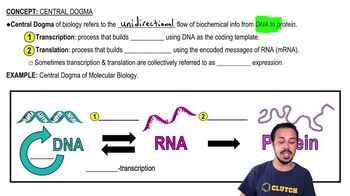
The central dogma describes the flow of genetic information: DNA is transcribed into RNA, which is then translated into protein.
mRNA is read by the ribosome in the 5’ to 3’ direction during translation.
A codon is a sequence of three nucleotides on mRNA that codes for a specific amino acid or a stop signal during translation.
The start codon is AUG and it codes for the amino acid methionine (Met).
Stop codons signal the end of translation. They are UAA, UAG, and UGA.
tRNA carries specific amino acids to the ribosome and has an anticodon that base pairs with the mRNA codon.
The tRNA anticodon is antiparallel and complementary to the mRNA codon, allowing hydrogen bonding between bases.
The ribosome has three sites: A (aminoacyl), P (peptidyl), and E (exit) sites for tRNA binding and movement.
The small ribosomal subunit binds mRNA and initiator tRNA at the start codon, then the large subunit joins to form the initiation complex.
During elongation, tRNAs bring amino acids to the ribosome, peptide bonds form between amino acids, and the ribosome moves along mRNA codon by codon.
When a stop codon enters the A site, release factors bind, causing the polypeptide to be released and the ribosome to disassemble.
A polyribosome is a complex of multiple ribosomes simultaneously translating a single mRNA molecule.
The genetic code specifies 20 common amino acids.
The genetic code is redundant (multiple codons can code for the same amino acid) but not ambiguous.
The template strand is used by RNA polymerase to synthesize mRNA, which is complementary and antiparallel; the coding strand has the same sequence as mRNA (except T instead of U).
Aminoacyl tRNA synthetase is an enzyme that charges tRNA by attaching the correct amino acid to its corresponding tRNA.
Polypeptides are synthesized from the N-terminus to the C-terminus during translation.
The 5’ cap and poly-A tail protect mRNA from degradation and assist in translation initiation and stability.
rRNA forms the core of the ribosome's structure and catalyzes peptide bond formation as a ribozyme.
Proteins destined for secretion or membranes are synthesized on ribosomes bound to the rough endoplasmic reticulum (RER), while others are made on free ribosomes in the cytoplasm.