Skip to main content
General Biology
나의 코스
배우기
시험 준비
AI 튜터
학습 가이드
교과서적 해결책
플래시카드
탐험해 보세요
앱을 사용해 보세요
나의 코스
배우기
시험 준비
AI 튜터
학습 가이드
교과서적 해결책
플래시카드
탐험해 보세요
앱을 사용해 보세요
뒤로
General Biology: Tree of Life and Evolutionary Concepts
카드를 뒤집기 위해 탭할 수 있습니다.
What is the Tree of Life?
카드를 뒤집기 위해 탭할 수 있습니다.
👆
What is the Tree of Life?
A metaphor describing evolutionary relationships among all living organisms, showing how species diverge from common ancestors in a branching pattern.
진행 상황 추적
컨트롤 버튼이 '내비게이션' 모드로 변경되었습니다.
1/27
추천 영상
02:32
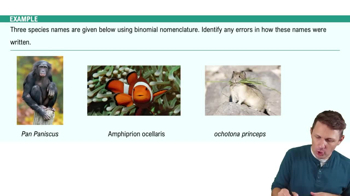
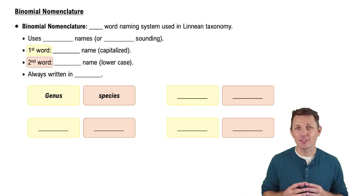
Binomial Nomenclature
3312
views
46
rank
06:57
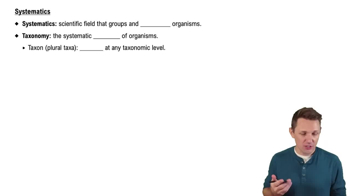
Systematics
4060
views
84
rank
01:31
Introduction to Phylogeny Example 1
2825
views
33
rank
이 집합의 용어 (27)
하이드의 정의
What is the Tree of Life?
A metaphor describing evolutionary relationships among all living organisms, showing how species diverge from common ancestors in a branching pattern.
What is a phylogenetic tree?
A visual hypothesis of the evolutionary history of populations, genes, or species, constructed using data to show relationships among taxa.
Define the 'root' of a phylogenetic tree.
The most ancestral branch in the tree representing the common ancestor of all taxa in the tree.
What does a 'node' represent in a phylogenetic tree?
A point where a branch splits into two or more branches, representing the most recent common ancestor of the descendant groups.
What is a polytomy in a phylogenetic tree?
A node that divides into three or more branches, indicating uncertainty in the evolutionary relationships.
Differentiate between ancestral and derived traits.
Ancestral trait (plesiomorphy)
: existed in an ancestor;
Derived trait (apomorphy)
: a modified form found in descendants.
What is homology?
Traits shared among taxa due to inheritance from a common ancestor.
What is homoplasy?
Traits that evolved independently in different lineages, often due to similar environmental pressures (convergent evolution).
Define a monophyletic group (clade).
Includes an ancestral species and all its descendants.
What is a paraphyletic group?
Includes an ancestral species and some, but not all, of its descendants.
What is a polyphyletic group?
Does not include the most recent common ancestor of all members.
What is the principle of parsimony in tree construction?
The simplest explanation with the fewest evolutionary changes is preferred.
What can branch lengths in phylogenetic trees represent?
They can represent arbitrary patterns, genetic differences, or evolutionary time between nodes.
Explain convergent evolution.
Independent evolution of similar traits in distantly related organisms due to similar environmental pressures.
How does molecular data support whale evolution?
DNA sequences and SINEs show whales are closely related to hippos within the artiodactyl clade.
What is the fossil record?
The total collection of fossils worldwide, providing direct evidence of past organisms' appearance, location, and age.
List limitations of the fossil record.
Includes habitat bias, taxonomic and tissue bias, temporal bias, and abundance bias.
What is radiometric dating?
A method using radioactive decay to assign absolute dates to events in the fossil record.
Name the major eras of the Phanerozoic eon.
Paleozoic, Mesozoic, and Cenozoic.
What is adaptive radiation?
Rapid production of many descendant species from a single lineage, often after a key trait evolves or new resources become available.
What triggered the Cambrian explosion?
Higher oxygen levels, evolution of predation, new ecological niches, and gene duplications like Hox genes.
Define mass extinction.
Rapid extinction of at least 60% of species within a million years due to catastrophic events.
What caused the End-Permian mass extinction?
Extreme volcanism leading to anoxic oceans, acid rain, and habitat loss.
What caused the End-Cretaceous mass extinction?
Likely an asteroid impact causing wildfires, tsunamis, acid rain, and global cooling.
What is the Sixth Mass Extinction?
The current rapid loss of species driven mainly by human activities like habitat loss and climate change.
Define phylogeny.
The evolutionary history of a group of organisms.
What is a clade?
A monophyletic group including an ancestor and all its descendants.
 뒤로뒤로
 02:32