 뒤로
General Biology Unit 1-5 Key Concepts
 09:26

이 집합의 용어 (38)
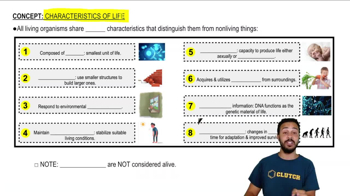
Order, reproduction, growth and development, response to the environment, energy processing, regulation, evolutionary adaptation
Domain, Kingdom, Phylum, Class, Order, Family, Genus, Species
Biosphere, Ecosystem, Community, Population, Organism, Organ Systems, Organ, Tissue, Cell, Organelle, Molecule
Observation, question, hypothesis (testable and falsifiable), experiment, data analysis, accept or reject hypothesis
Independent variable is manipulated; dependent variable responds and is measured (DRY MIX: Dependent Responds Y-axis, Independent Manipulated X-axis)
Process by which species accumulate differences over time due to adaptation; not goal-directed or perfect
Carbon, Hydrogen, Oxygen, Nitrogen (CHON)
Iodine: goiter, mental impairment; iodized salt
Iron: fatigue, pale skin; fortified flour
Fluorine: tooth decay prevention; fluoridated water
Protons: positive, nucleus
Neutrons: neutral, nucleus
Electrons: negative, orbit nucleus
Ion: atom with gained/lost electrons
Cation: positive ion (lost electron)
Anion: negative ion (gained electron)
Ionic bond: electron transfer
Covalent bond: electron sharing (polar or nonpolar)
Atoms gain, lose, or share electrons to complete their valence shell
Tendency of an atom to attract electrons
Attraction between partial positive hydrogen and partial negative oxygen of different water molecules; individually weak but collectively strong
Atoms of the same element with different numbers of neutrons
Polar molecules have partial charges; water's polarity enables hydrogen bonding, leading to high specific heat and cohesion
Cohesion: water molecules stick to each other
Adhesion: water molecules stick to other substances
Hydrogen bonds absorb and release heat when breaking/forming, requiring much energy to change temperature
Hydrophilic: water-loving, usually polar
Hydrophobic: water-fearing, usually nonpolar
CO2 forms carbonic acid, releasing H+ that reduces carbonate availability needed for calcium carbonate skeletons
Carbon forms 4 covalent bonds due to 4 valence electrons
Hydrocarbons are nonpolar due to even sharing of electrons between carbon and hydrogen
Structural: different atom arrangement
Cis-trans: same bonds, different spatial arrangement
Enantiomers: non-superimposable mirror images
Hydroxyl, Carbonyl, Carboxyl, Amino, Sulfhydryl (polar); Methyl (nonpolar)
Monomers are building blocks; polymers are long chains of monomers
Breaking polymers by adding water, removing one monomer at a time
Joining monomers by removing water, forming a covalent bond
Monomers: monosaccharides
Polymers: polysaccharides
Saturated: all single bonds, mostly animal fats
Unsaturated: one or more double bonds (kinks), mostly plants and fish fats
Phospholipids have hydrophilic heads and hydrophobic tails, making them amphipathic
Primary: amino acid sequence
Secondary: alpha-helix and beta-sheets from hydrogen bonds
Tertiary: 3D folding from R group interactions
Quaternary: multiple polypeptides combined
Loss of a protein's native structure and function
Phosphate group, sugar (deoxyribose or ribose), and nitrogenous base
DNA: A-T, C-G
RNA: A-U, C-G
Covalent bond between monosaccharides; humans hydrolyze 1,4 α linkages but not cellulose
Bond joining fatty acids to glycerol in triglycerides
Covalent bond joining amino acids in proteins
Bond linking nucleotides in nucleic acids via phosphate and sugar