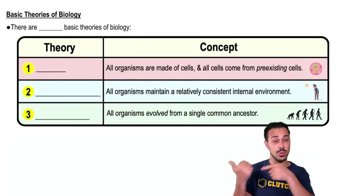
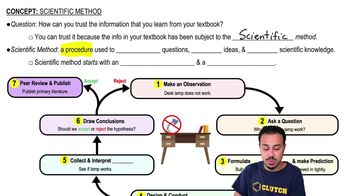
A systematic process involving observation, hypothesis, experimentation, analysis, and conclusion to test scientific questions.
Two types of reasoning in science
Deductive reasoning starts with a general statement to reach a specific conclusion; inductive reasoning uses specific observations to form a general conclusion.
Hierarchy of Life
Levels of biological organization from atoms to biosphere, including molecules, cells, tissues, organs, organisms, populations, communities, and ecosystems.
Matter
Anything that has mass and takes up space; composed of elements and compounds.
Atom
The smallest unit of an element, consisting of protons, neutrons, and electrons.
Atomic number vs Atomic mass
Atomic number is the number of protons; atomic mass is the total number of protons and neutrons.
Isotopes
Atoms of the same element with different numbers of neutrons; some are radioactive and used in medical imaging and research.
Ions: cations vs anions
Ions are charged atoms; cations are positively charged, anions are negatively charged.
Ionic bond
A chemical bond formed by the transfer of electrons between atoms, resulting in attraction between oppositely charged ions.
Covalent bond
A chemical bond where atoms share one or more pairs of electrons.
Hydrogen bond
A weak bond between a hydrogen atom in one molecule and an electronegative atom in another, important in water properties.
Water as a solvent
Water is a polar molecule that dissolves many substances, making it a universal solvent.
Hydrophilic vs Hydrophobic
Hydrophilic substances interact with water; hydrophobic substances repel water.
pH scale
Measures acidity or alkalinity of a solution; ranges from 0 (acidic) to 14 (basic), with 7 as neutral.
Why carbon forms covalent bonds
Carbon has four valence electrons, allowing it to form four stable covalent bonds, making it versatile for complex molecules.
Functional groups in organic molecules
Specific groups of atoms like hydroxyl, carbonyl, carboxyl, amino, phosphate, and methyl that determine molecule properties.
Monomers and polymers
Monomers are small building blocks; polymers are large molecules made by linking monomers via dehydration reactions.
Dehydration vs hydrolysis
Dehydration removes water to form bonds; hydrolysis adds water to break bonds.
Carbohydrates general formula
Typically \((CH_2O)_n\), where n is the number of carbon atoms.
Aldose vs Ketose sugars
Aldoses have a carbonyl group at the end of the molecule; ketoses have it within the carbon chain.
Glycosidic bond
A covalent bond that joins two monosaccharides to form a disaccharide.
Examples of polysaccharides
Starch, glycogen, and cellulose are biologically important polysaccharides used for energy storage and structure.
Lipids and their bonds
Lipids are formed by dehydration reactions creating ester bonds between glycerol and fatty acids.
Saturated vs unsaturated fats
Saturated fats have no double bonds and are solid at room temperature; unsaturated fats have double bonds causing kinks and are liquid.
Phospholipids structure
Contain hydrophilic heads and hydrophobic tails; form bilayers essential for cell membranes.
Protein functions
Proteins serve as enzymes, structural components, signaling molecules, and more.
Amino acid structure
Consists of an amino group, carboxyl group, hydrogen atom, and unique R group attached to a central carbon.
 뒤로
 01:35