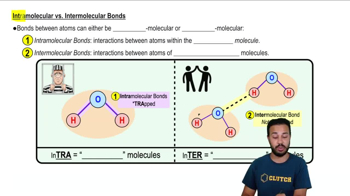
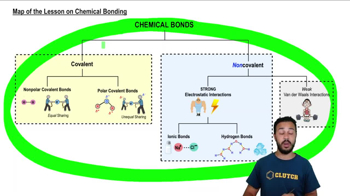
Nonpolar covalent bonds share electrons equally, such as C-C or C-H bonds.
What makes a covalent bond polar?
Polar covalent bonds share electrons unequally due to differences in electronegativity, e.g., O-H or C-O bonds.
Why is water a polar molecule?
Water is polar because it has polar covalent bonds and an asymmetrical shape, causing partial positive and negative regions.
What is electronegativity and how does it relate to water's polarity?
Electronegativity is an atom's ability to attract electrons; oxygen is more electronegative than hydrogen, pulling electrons closer and creating polarity.
What are hydrogen bonds in water?
Hydrogen bonds are weak attractions between the partially positive hydrogen of one water molecule and the partially negative oxygen or nitrogen of another.
How strong are hydrogen bonds compared to covalent bonds?
Each hydrogen bond is about 5% as strong as a covalent bond, but many together create significant effects.
Name three emergent properties of water due to hydrogen bonding.
Cohesion/adhesion, high specific heat and heat of vaporization, and ice floating due to lower density.
What is cohesion in water?
Cohesion is the attraction between water molecules due to hydrogen bonding.
What is adhesion in water?
Adhesion is the attraction between water molecules and other polar molecules.
Why does water have a high specific heat?
Because hydrogen bonds absorb heat when breaking, water resists temperature changes, stabilizing environments.
Why does ice float on water?
Ice forms a crystal structure stabilized by hydrogen bonds, making it less dense than liquid water.
What does it mean that water is a good solvent for polar solutes?
Water dissolves polar molecules because its partial charges interact with and separate solute molecules or ions.
What is hydrophobic and give an example?
Hydrophobic molecules are nonpolar and do not dissolve in water, e.g., oils and fats.
What is hydrophilic and give an example?
Hydrophilic molecules are polar and interact well with water, e.g., salt and sugar.
Are electrons shared in hydrogen bonds?
No, hydrogen bonds are noncovalent and do not involve sharing electrons.
How do hydrogen bonds contribute to DNA structure?
Hydrogen bonds hold complementary base pairs together, stabilizing the DNA double helix.
What is pH a measure of?
pH measures the concentration of hydrogen ions \([H^+]\) in a solution.
How is pH calculated?
pH = -log10 \([H^+]\), a logarithmic scale of hydrogen ion concentration.
What does a pH of 7 indicate?
A pH of 7 is neutral, meaning \([H^+] = [OH^-]\) in pure water.
How does pH change with hydrogen ion concentration?
Each pH unit change represents a tenfold change in \([H^+]\) concentration.
What is the role of buffers in biological systems?
Buffers resist changes in pH by accepting or donating hydrogen ions to maintain stable conditions.
What happens to hydrogen bonds when water evaporates?
Hydrogen bonds break, allowing water molecules to escape as vapor, which cools surfaces (evaporative cooling).
Why is water's polarity important for membrane structure?
Water's polarity drives the formation of hydrophobic and hydrophilic regions, essential for phospholipid bilayer formation.
What is the difference between polar and nonpolar molecules in water?
Polar molecules dissolve in water (hydrophilic), while nonpolar molecules do not (hydrophobic).
 뒤로
 1:59