Water is polar because oxygen has a higher electronegativity, pulling shared electrons closer and creating a slight negative charge on oxygen and a slight positive charge on hydrogen.
What are hydrogen bonds in water?
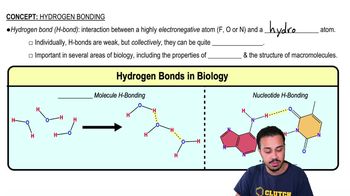
Hydrogen bonds are weak attractions between the slightly positive hydrogen of one water molecule and the slightly negative oxygen of another.
How does cohesion relate to water?
Cohesion is the tendency of water molecules to stick together due to hydrogen bonding.
Why can insects walk on water?
Insects can walk on water because surface tension arises from cohesive hydrogen bonds between water molecules.
How do hydrogen bonds affect water's heat capacity?
Hydrogen bonds require a lot of energy to break, so water can absorb much heat without a large temperature increase.
What causes evaporative cooling in water?
When water evaporates, molecules with high energy leave, taking heat away and cooling the surface.
Why is ice less dense than liquid water?
In ice, stable hydrogen bonds hold molecules farther apart, making ice less dense and able to float.
What is a solvent, solute, and solution?
A solvent dissolves substances; a solute is dissolved; a solution is a uniform mixture of solvent and solute.
Why is water called the solvent of life?
Water's polarity allows it to dissolve many polar and charged substances, forming aqueous solutions essential for life.
What ions form when water dissociates?
Water dissociates into hydrogen ions (H+) and hydroxide ions (OH–), both highly reactive.
How is acidity measured and what does pH indicate?
Acidity is measured by pH; pH less than 7 is acidic, 7 is neutral, and greater than 7 is basic.
What is the role of buffers in biological systems?
Buffers resist pH changes by accepting excess H+ ions or donating H+ ions when depleted.
What are lipids and their main characteristics?
Lipids are hydrophobic molecules mainly made of carbon and hydrogen, important for long-term energy storage.
What are the three main types of lipids?
Fats, phospholipids, and steroids.
What is the structure of a fat (triglyceride)?
A fat consists of one glycerol molecule linked to three fatty acids via dehydration reactions.
Difference between saturated and unsaturated fatty acids?
Saturated fatty acids have no double bonds and maximum hydrogens; unsaturated have one or more double bonds causing kinks.
What are phospholipids and their role in membranes?
Phospholipids have two fatty acids and a phosphate group; they form bilayers that make up cell membranes.
How do phospholipid bilayers arrange in water?
Hydrophilic heads face water inside and outside the cell; hydrophobic tails face inward, away from water.
What is the function of cholesterol in membranes?
Cholesterol stabilizes membrane fluidity by preventing tight packing at warm temperatures and maintaining fluidity at cold temperatures.
What is the fluid mosaic model of membranes?
Membranes are flexible bilayers of phospholipids with embedded proteins that perform various functions.
What are some functions of membrane proteins?
Membrane proteins maintain cell shape, act as receptors, enzymes, participate in cell recognition, and form intercellular junctions.
What is passive transport?
Passive transport is the diffusion of molecules across membranes without energy input, moving down their concentration gradient.
Define osmosis.
Osmosis is the diffusion of water across a selectively permeable membrane from low to high solute concentration.
What happens to animal cells in isotonic, hypotonic, and hypertonic solutions?
Isotonic: no volume change; hypotonic: water enters, cell may burst; hypertonic: water leaves, cell shrinks.
What is osmoregulation?
Osmoregulation is the control of water balance to maintain cell survival in varying environments.
How do plant cell walls affect water balance?
Cell walls prevent plant cells from bursting in hypotonic solutions by exerting pressure; in hypertonic solutions, cells shrivel.
 뒤로
 05:03
