Skip to main content
General Biology
나의 코스
배우기
시험 준비
AI 튜터
학습 가이드
교과서적 해결책
플래시카드
탐험해 보세요
앱을 사용해 보세요
나의 코스
배우기
시험 준비
AI 튜터
학습 가이드
교과서적 해결책
플래시카드
탐험해 보세요
앱을 사용해 보세요
뒤로
General Biology: What Is Life? Microscopy, Cells, and Macromolecules
카드를 뒤집기 위해 탭할 수 있습니다.
What are the two major cell types in living organisms?
카드를 뒤집기 위해 탭할 수 있습니다.
👆
What are the two major cell types in living organisms?
Prokaryotic
and
eukaryotic
cells, differing in complexity and structure but both carrying out all functions of life.
진행 상황 추적
컨트롤 버튼이 '내비게이션' 모드로 변경되었습니다.
1/27
추천 영상
06:35
Microscopes
24933
views
567
rank
02:52
Types of Electron Microscopes
17888
views
357
rank
1
comments
이 집합의 용어 (27)
하이드의 정의
What are the two major cell types in living organisms?
Prokaryotic
and
eukaryotic
cells, differing in complexity and structure but both carrying out all functions of life.
What is magnification in microscopy?
Magnification = size of the image / size of the object; total magnification = ocular magnification × objective magnification.
How is resolution defined in microscopy?
Resolution is the ability to distinguish two points as separate; better resolution means smaller minimum distance between points.
What factors affect resolution distance (RD) in microscopy?
RD = λ / 2NA, where λ is wavelength of illumination and NA is numerical aperture of the lens.
What is numerical aperture (NA) and how is it calculated?
NA = n sine α, where n is refractive index and α is half the angular aperture of the objective lens.
Why is immersion oil used in microscopy?
Immersion oil has a refractive index similar to glass, reducing light bending and increasing numerical aperture and resolution.
What is the difference between a dissecting microscope and a compound light microscope?
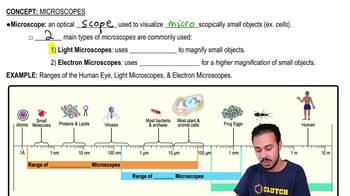
Dissecting microscopes view larger specimens at low magnification (~10×–80×); compound microscopes view cells and microorganisms at higher magnifications (~40×–1000×).
How do prokaryotic and eukaryotic cells differ structurally?
Prokaryotes lack a nucleus and membrane-bound organelles; eukaryotes have a nucleus and membrane-bound organelles.
What are common shapes of prokaryotic cells?
Coccus (sphere), bacillus (rod), and spirillus (spiral).
What is the typical size range of prokaryotic and eukaryotic cells?
Prokaryotes: 1–10 µm; eukaryotes: 10–100 µm.
What are the three common methods of motility in microorganisms?
Flagellar movement using flagella
Ciliary movement using cilia
Amoeboid movement using pseudopodia
What is the operational definition of organic matter used in the burn test?
Organic matter contains hydrocarbon bonds that burn, releasing CO2 and water, leaving inorganic ash.
How do you calculate the percentage of water in a biological sample?
Water % = ((wet weight - dry weight) / wet weight) × 100%.
What does Benedict's test detect?
Presence of reducing sugars, indicated by a color change from blue to red cupric oxide upon heating.
What does the iodine test detect?
Presence of starch, indicated by a black-blue color change.
How is protein detected in a sample?
Using Biuret's test, which produces a purple color in presence of proteins.
How can you test for fats and oils qualitatively?
Place sample on unglazed paper; a permanent translucent spot indicates fats or oils.
How is density calculated for biological samples?
Density = mass / volume, with volume often measured by water displacement.
What is field diameter in microscopy?
The diameter of the visible area under the microscope; inversely related to magnification.
How does depth of focus change with magnification?
Depth of focus decreases as magnification increases.
What is the significance of the constant in field diameter calculations?
Field diameter × total magnification = constant for a given microscope, allowing calculation of field diameter at different magnifications.
What is the difference in image orientation between dissecting and compound microscopes?
Dissecting microscopes show images with the same orientation as the specimen; compound microscopes invert and reverse the image.
What is the main function of dialysis tubing in the model cell experiment?
To simulate a selectively permeable membrane allowing diffusion of certain molecules.
What is the role of the substage condenser in microscopy?
Controls the angle and cone of light reaching the specimen, improving resolution.
Why is resolution more important than magnification in microscopy?
Because magnification alone cannot reveal more detail if resolution is poor.
What is the typical resolving power of the human eye compared to light microscopes?
Human eye: ~200 µm; best light microscopes: ~200 nm (1000× better).
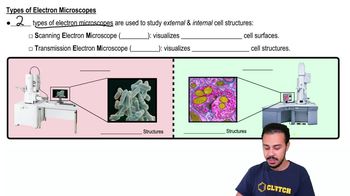
How do electron microscopes achieve higher resolution than light microscopes?
By using electron beams with much shorter wavelengths than visible light.
 뒤로
 06:35

 뒤로