 뒤로
Intro Bio 1 - CH. 5
 03:08

이 집합의 용어 (30)
What are the three main types of carbohydrates based on polymer size?
Monosaccharides (one sugar) monomers, oligosaccharides (few sugars) small polymers, and polysaccharides (many sugars) large polymers.
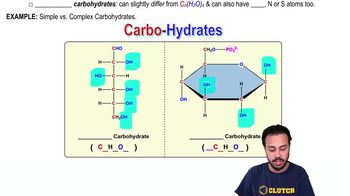
What is the general molecular formula of carbohydrates?
Carbohydrates have the formula (CH2O)n, where n varies from 3 to over 1000.
"n" = number of carbon hydrate groups
What functional groups are characteristic of carbohydrates?
Carbohydrates contain a carbonyl group (C=O), multiple hydroxyl groups (-OH), and many carbon-hydrogen bonds (C–H).
How are monosaccharides classified by the location of their carbonyl group?
If the carbonyl group is at the end of the carbon chain, the sugar is an aldose. If it is within the chain, it is a ketose.
What are the common carbon chain lengths in monosaccharides?
Monosaccharides commonly have 3 carbons (triose), 5 carbons (pentose), or 6 carbons (hexose).
How do monosaccharides differ in spatial arrangement?
Monosaccharides vary in the arrangement of hydroxyl groups and can exist in linear or ring forms, affecting their function.
What type of bond links monosaccharides to form disaccharides and polysaccharides? How can these bonds be broken?
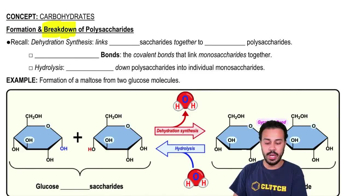
A glycosidic linkage formed by a condensation reaction between two hydroxyl groups.
Can be broken by hydrolysis reaction (add H2O)
What are the two common types of glycosidic linkages in glucose polymers?
α-1,4-glycosidic linkage and β-1,4-glycosidic linkage, both between C-1 and C-4 carbons but differing in geometry.
They both connect Carbon-1 of one sugar to Carbon-4 of another, but differ in direction at C-1: α points down, while β points up.
What is the structural difference between starch and cellulose?
Starch has α-1,4-glycosidic linkages forming a helix, while cellulose has β-1,4-glycosidic linkages with every other glucose flipped, forming linear fibers.
What are amylose and amylopectin?
Amylose is an unbranched starch with only α-1,4 linkages; amylopectin is a branched starch with α-1,6 linkages at branch points (abt 30 monomers).
*Branched -splits off into a second chain instead of staying as one long line
How is glycogen different from starch?
Glycogen is a highly branched α-glucose polymer stored in animals, with branches about every 1 in 10 monomers, compared to starch's less frequent branching.
What is cellulose's role in plants? Structure & Composition?
Cellulose is a structural polysaccharide forming the plant cell wall, providing strength and rigidity.
Made of β glucose monomers linked by β-1,4 linkages; every other glucose is flipped --> linear model
What is chitin and where is it found?
Chitin is a structural polysaccharide in fungal cell walls and insect exoskeletons, composed of N-acetylglucosamine monomers linked by β-1,4 bonds (every other monomer is flipped)
What is peptidoglycan and its function?
Bacterial cell wall polymer
Long backbones of alternating polysaccharides
Joined by B-1,4-glycosidic linkages
Short amino acid chains form peptide bonds between adjacent strands
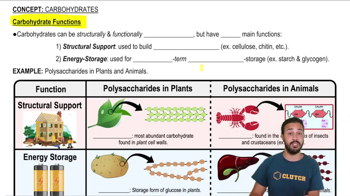
What functions do carbohydrates have?
Serve as precursors to other molecules, such as nucleotides and amino acids
Provide fibrous structural materials
Indicate cell identity
Store chemical energy
Why are β-1,4-glycosidic linkages difficult to hydrolyze?
Most organisms lack enzymes to break β-1,4 linkages, and the fibers formed exclude water, making hydrolysis challenging.
How do carbohydrates store energy compared to CO2?
Carbohydrates store lots of energy because their C–H and C–C bonds have high potential energy; their electrons are held less tightly than in the C=O and C-O bonds of CO₂, where electrons have lower potential energy.
Which enzymes hydrolyze starch and glycogen? Are they easily hydrolyzed?
Starch is hydrolyzed by amylase enzymes; glycogen is hydrolyzed by phosphorylase (into glucose).
Yes, because they have a-glycosidic linkages (alpha linkages = easier to break → starch/glycogen can be quickly used for energy)
How is energy from glucose used in cells?
Glucose breakdown releases energy used to synthesize ATP, which powers cellular processes/other reactions like polymerization and muscle movement.
What is the significance of carbohydrate ring forms?
Sugars typically form ring structures in water, which affects their chemical reactivity and biological function.
Carbohydrates three main roles?
Cell structure, cell identity, and energy storage
What are the monomers of carbohydrates? What role does it play?
Sugars
Provide chemical energy in cells ; serve as building blocks for larger compounds; also played important role in chemical evolution (ex: ribose needed for nucleotide formation)
What distinguishes one monosaccharide from another?
Location of carbonyl group (end-aldose, middle-ketose)
Number of carbon atoms present (triose, pentose, hexose)
Spatial arrangement of their atoms (ex: diff arrangement of hydroxyl groups –OH)
Linear & alternative ring forms
What is a carbonyl group?
A chemical functional group consisting of a carbon atom double-bonded to an oxygen atom written as C=O
Why do distinct monosaccharides exist?
Because so many aspects of their structure are variable (ex: carbon #, aldose or ketose placement, etc.)
What are polysaccharides? Disaccharides?
They are complex carbohydrates and are polymers of monosaccharide monomers
Two sugars/monosaccharides linked together 2
Five main types of polysaccharides?
Starch (plants, storage)
Glycogen (animals; storage)
Cellulose (plants; structural)
Chitin (fungi & animals; structural)
Peptidoglycan (bacteria; structural)
What is starch? Where is it found? What its structure & composition?
Sugar is stored as starch in plants
Composed of a-glucose monomers
Forms a helix (amylose, amylopectin)
Why are cellulose and chitin similar? Different?
Structural polysaccharide; forms long, straight chains w/ β-1,4 glycosidic linkages.
Cellulose is found in plants, chitin in fungi & animals
How do carbohydrates contribute to cell identity?
Carbohydrates on the cell surface act like an “ID badge.” They are attached to proteins (glycoproteins) or lipids (glycolipids) and help cells recognize each other and communicate.