 뒤로
Introduction to Carbohydrates - General Biology
 03:08

이 집합의 용어 (20)
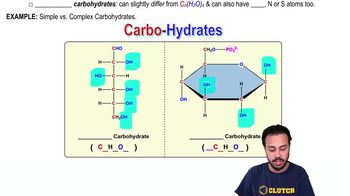
Carbohydrates are organic molecules made of carbon, hydrogen, and oxygen, typically in a 1:2:1 ratio, and serve as a primary energy source for living organisms.
The general formula of carbohydrates is \(C_nH_{2n}O_n\), where n is the number of carbon atoms.
Monosaccharides are the simplest carbohydrates, consisting of a single sugar unit, such as glucose, fructose, and galactose.
Monosaccharides provide immediate energy and serve as building blocks for more complex carbohydrates.
Disaccharides are carbohydrates composed of two monosaccharide units linked by a glycosidic bond, e.g., sucrose, lactose, and maltose.
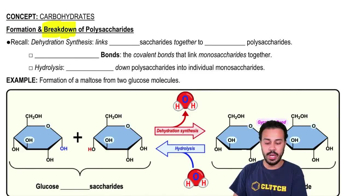
Disaccharides form through a dehydration synthesis reaction, where a water molecule is removed as two monosaccharides bond.
Polysaccharides are long chains of monosaccharides linked together, serving as energy storage or structural components.
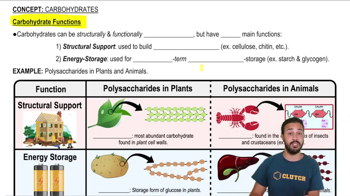
Starch stores energy in plants; glycogen stores energy in animals; cellulose provides structural support in plant cell walls.
Starch is a storage polysaccharide with alpha linkages, digestible by humans; cellulose has beta linkages, forming rigid structures and is indigestible by humans.
Monosaccharides are linked by glycosidic bonds, formed via dehydration synthesis.
Carbohydrates also provide structural support and serve as recognition molecules on cell surfaces.
It is a chemical reaction where two molecules join by removing a water molecule, forming a glycosidic bond between sugars.
Hydrolysis breaks glycosidic bonds by adding water, releasing monosaccharides for energy use.
They provide energy, store energy, contribute to cell structure, and participate in cell recognition and signaling.
Glucose is a key monosaccharide that serves as the primary energy source for cells.
Aldoses have an aldehyde group; ketoses have a ketone group in their structure.
Isomers like glucose and fructose have the same formula but different structures, affecting their function and metabolism.
Carbohydrates on cell surfaces act as markers for cell-cell recognition and communication.
Alpha linkages result in helical structures (e.g., starch); beta linkages form straight chains (e.g., cellulose).
Lactose is a disaccharide sugar found in milk, composed of glucose and galactose.