 뒤로
Introduction to Metabolism - General Biology
 02:17

이 집합의 용어 (28)
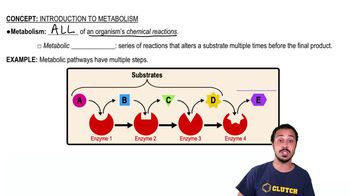
Metabolism is the totality of an organism’s chemical reactions, arising from orderly molecular interactions.
Metabolic pathways alter specific molecules in a series of steps, each catalyzed by a specific enzyme to produce a product.
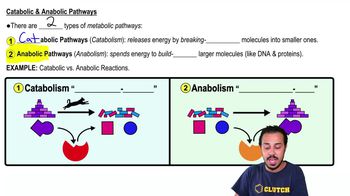
Catabolic pathways release energy by breaking down complex molecules; anabolic pathways consume energy to build complex molecules.
Bioenergetics is the study of how energy flows through living organisms.
Kinetic energy is energy of motion; potential energy is energy due to position or structure, such as chemical energy in bonds.
Chemical energy is potential energy available for release in a chemical reaction, stored in molecules like glucose.
Energy cannot be created or destroyed, only transferred or transformed; total energy of the universe is constant.
Every energy transfer increases the entropy (disorder) of the universe.
Entropy is a measure of molecular disorder or randomness.
Gibbs free energy is the portion of a system’s energy that can do work at constant temperature and pressure.
ΔG = ΔH – TΔS, where ΔG is free energy change, ΔH is enthalpy change, T is temperature in Kelvin, and ΔS is entropy change.
A negative ΔG means the reaction is spontaneous and releases free energy, making the system more stable.
Exergonic reactions release free energy (ΔG < 0); endergonic reactions absorb free energy (ΔG > 0).
Cells are open systems with constant material flow, preventing equilibrium and allowing continuous work.
Chemical work (endergonic reactions), transport work (pumping substances), and mechanical work (movement like muscle contraction).
ATP couples exergonic reactions to endergonic ones, providing energy by hydrolysis of its terminal phosphate bond.
ATP consists of ribose sugar, adenine base, and three phosphate groups linked in a triphosphate tail.
ATP loses a phosphate group, releasing energy and forming ADP and inorganic phosphate.
Enzymes lower the activation energy (EA) barrier, allowing reactions to proceed faster without changing ΔG.
EA is the initial energy needed to contort reactants into a transition state to start a reaction.
Enzymes bind specific substrates at their active site due to complementary shapes, enabling selective catalysis.
Substrate binding causes the enzyme to change shape, tightening around the substrate to enhance catalysis.
Temperature, pH, substrate concentration, and presence of cofactors or inhibitors affect enzyme function.
Competitive inhibitors bind active site blocking substrate; noncompetitive bind elsewhere causing shape change.
Regulatory molecules bind to sites other than the active site, altering enzyme activity positively or negatively.
Binding of substrate to one active site stabilizes active form of other sites, amplifying enzyme activity.
The end product of a metabolic pathway inhibits an earlier enzyme to prevent overproduction.
Enzymes localized in specific organelles or complexes organize metabolic pathways efficiently.