 뒤로
Macromolecules in General Biology
 01:17

이 집합의 용어 (20)
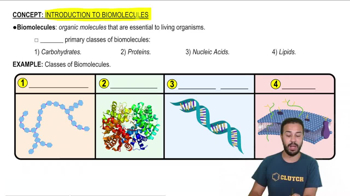
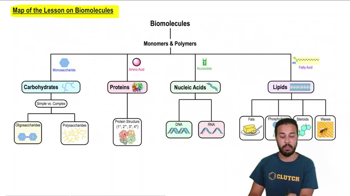
Macromolecules are large, complex molecules essential for life, typically formed by polymerization of smaller units called monomers.
Carbohydrates, lipids, proteins, and nucleic acids.
Monomers are small, repeating molecular units that join to form polymers or macromolecules.
A polymer is a large molecule made by linking many monomers together.
Carbohydrates provide energy and structural support in cells.
Monosaccharides are simple sugars and the monomers of carbohydrates, e.g., glucose.
Lipids are hydrophobic molecules mainly used for energy storage and membrane structure.
Amino acids are the monomers that make up proteins.
Proteins perform diverse functions including enzymatic catalysis, structural support, and signaling.
Nucleic acids are polymers of nucleotides, which store and transmit genetic information.
DNA (deoxyribonucleic acid) and RNA (ribonucleic acid).
Peptide bonds link amino acids in proteins.
Monosaccharides are linked by glycosidic bonds to form polysaccharides.
A chemical reaction that joins monomers by removing a water molecule.
A reaction that breaks polymers into monomers by adding water.
Starch is a polysaccharide used for energy storage in plants.
Cellulose provides structural support in plant cell walls.
Saturated lipids have no double bonds; unsaturated lipids have one or more double bonds in their fatty acid chains.
A nucleotide consists of a phosphate group, a sugar, and a nitrogenous base.
DNA stores genetic information used for inheritance and protein synthesis.