Skip to main content
General Biology
나의 코스
배우기
시험 준비
AI 튜터
학습 가이드
교과서적 해결책
플래시카드
탐험해 보세요
앱을 사용해 보세요
나의 코스
배우기
시험 준비
AI 튜터
학습 가이드
교과서적 해결책
플래시카드
탐험해 보세요
앱을 사용해 보세요
뒤로
Mammals: Major Groups and Evolutionary Traits
카드를 뒤집기 위해 탭할 수 있습니다.
What are the two main clades of mammals?
카드를 뒤집기 위해 탭할 수 있습니다.
👆
What are the two main clades of mammals?
Monotremes
(egg-laying) and
Non-monotremes
(live birth, includes marsupials and placentals).
진행 상황 추적
컨트롤 버튼이 '내비게이션' 모드로 변경되었습니다.
1/20
추천 영상
01:37
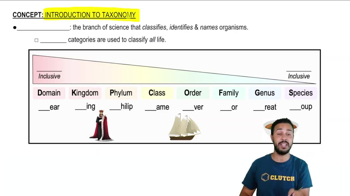
Introduction to Taxonomy Example 2
16368
views
338
rank
2
comments
05:48
Categorizing Life Based on Energy Acquisition
17775
views
429
rank
3
comments
02:23
Introduction to Taxonomy
29622
views
680
rank
2
comments
이 집합의 용어 (20)
하이드의 정의
What are the two main clades of mammals?
Monotremes
(egg-laying) and
Non-monotremes
(live birth, includes marsupials and placentals).
How do monotremes reproduce?
Monotremes lay eggs instead of giving live birth.
What distinguishes marsupials from placentals in reproduction?
Marsupials have short pregnancies and most development occurs in a pouch; placentals have long pregnancies with a placenta for nutrient exchange.
Name the six most diverse groups of placental mammals.
Rodents, bats, moles & shrews, primates, even-toed hoofed mammals, and carnivores.
Why are monotremes and marsupials often mistakenly called primitive?
Because they have fewer species and unique reproductive traits, but they are equally evolved and adapted as placentals.
What are two shared derived characteristics that unite all mammals?
Milk production (mammary glands)
and
hair
.
What is the evolutionary origin of mammals?
Mammals evolved from extinct mammal-reptile ancestors called
synapsids
.
How many extant species of monotremes exist and what are examples?
Five species including the duck-billed platypus and four echidnas.
What is the formal name for non-monotreme mammals?
Theria, which includes marsupials (Metatherians) and placentals (Eutherians).
When did monotremes split from other mammals?
Approximately 170 million years ago.
When did marsupials and placentals diverge?
Around 160 million years ago.
What major event occurred 66 million years ago affecting mammals?
The extinction of non-avian dinosaurs, leading to an adaptive radiation of mammals.
What is adaptive radiation in the context of mammals?
A rapid burst of speciation creating many diverse mammal lineages after dinosaur extinction.
Why is it misleading to call marsupials primitive?
Their reproductive strategy is adaptive and successful in uncertain habitats, not a sign of being less evolved.
What ancestral traits do echidnas retain?
Egg-laying and lack of nipples, but they have rapid growth rates and other derived traits.
What unique defense does the male platypus have?
It can inject venom into rivals.
What is the problem with traditional taxonomic ranks in mammals?
Ranks like order or family are not equivalent across groups, making comparisons misleading.
How many major clades of placental mammals evolved in the adaptive radiation?
About 16 major clades.
Give examples of smaller placental mammal groups.
Odd-toed hoofed mammals, sloths, elephants, manatees, rabbits, and cetaceans.
Are any extant mammals truly primitive?
No, all living mammals have evolved and adapted; none represent ancestral primitive forms.
 뒤로뒤로
 01:37