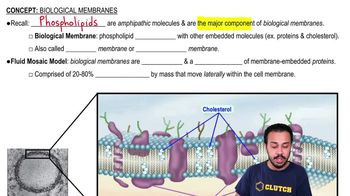
The membrane is a mosaic of protein molecules bobbing in a fluid bilayer of phospholipids, allowing lateral movement of proteins and lipids.
Phospholipid Bilayer
A double layer of phospholipids with hydrophilic heads facing outward and hydrophobic tails inward, forming the basic structure of membranes.
Amphipathic Molecules
Molecules that have both hydrophilic (water-attracting) and hydrophobic (water-repelling) regions, like phospholipids.
Membrane Fluidity Factors
Fluidity depends on temperature, saturation of fatty acid tails, and cholesterol content; unsaturated tails increase fluidity, cholesterol stabilizes it.
Integral vs Peripheral Proteins
Integral proteins penetrate the hydrophobic core of the bilayer; peripheral proteins are loosely bound to the membrane surface.
Functions of Membrane Proteins
Include transport, enzymatic activity, signal transduction, cell-cell recognition, intercellular joining, and attachment to cytoskeleton and ECM.
Selective Permeability
Membranes allow some substances to cross more easily than others, typically nonpolar molecules cross freely, polar molecules require transport proteins.
Diffusion
The movement of molecules from higher to lower concentration down their concentration gradient without energy input.
Osmosis
Diffusion of water across a selectively permeable membrane from lower to higher solute concentration.
Facilitated Diffusion
Passive transport of molecules across membranes via specific transport proteins, moving solutes down their concentration gradient.
Active Transport
Energy-requiring process that moves molecules against their concentration gradient using transport proteins and ATP.
Sodium-Potassium Pump
An active transport protein that pumps Na+ out and K+ into animal cells, maintaining membrane potential.
Cotransport
Active transport driven by the concentration gradient of another molecule, e.g., glucose uptake coupled with Na+ movement.
Exocytosis
Bulk transport process where large molecules are secreted out of the cell via vesicles fusing with the plasma membrane.
Endocytosis
Bulk transport process where cells take in large molecules by forming vesicles from the plasma membrane.
Phagocytosis
A type of endocytosis where large particles are engulfed by membrane extensions called pseudopodia, forming a phagosome.
Pinocytosis
A type of endocytosis involving nonspecific uptake of extracellular fluid and solutes into small vesicles.
Receptor-Mediated Endocytosis
Selective uptake of molecules using membrane receptors that cluster in coated pits forming vesicles.
Membrane Protein Mobility
Proteins can move laterally within the membrane but some are immobilized by attachments to the cytoskeleton or ECM.
Role of Cholesterol in Membranes
Cholesterol modulates membrane fluidity by reducing it at high temperatures and preventing solidification at low temperatures.
 뒤로
 02:21