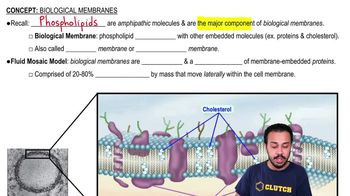
What are the main components of cellular membranes?
Lipids and proteins are the main components, with carbohydrates also playing an important role.
What is the structure of phospholipids in membranes?
Phospholipids are amphipathic molecules with hydrophobic tails inside the bilayer and hydrophilic heads exposed to water.
Describe the fluid mosaic model of membrane structure.
Membranes are a fluid mosaic of protein molecules bobbing in a fluid bilayer of phospholipids, with proteins often grouped by function.
How does temperature affect membrane fluidity?
Membranes switch from fluid to solid as temperature cools; fluidity depends on lipid composition, with unsaturated fatty acids increasing fluidity.
What role does cholesterol play in membrane fluidity?
Cholesterol reduces fluidity at moderate temperatures by restraining phospholipid movement and prevents solidification at low temperatures by disrupting packing.
What are the two major types of membrane proteins?
Peripheral proteins are bound to the membrane surface, and integral proteins penetrate the hydrophobic core.
What functions do cell-surface membrane proteins perform?
Functions include transport, enzymatic activity, signal transduction, cell-cell recognition, intercellular joining, and attachment to the cytoskeleton and extracellular matrix.
How does HIV use membrane proteins to infect cells?
HIV binds to the cell-surface protein CD4 and a co-receptor (CCR5 or CXCR4) to enter immune cells; lacking CCR5 confers resistance to some HIV strains.
What is selective permeability in membranes?
Membranes allow some substances to cross more easily than others, regulating molecular traffic based on size, polarity, and transport proteins.
How do hydrophobic and hydrophilic molecules cross the lipid bilayer?
Hydrophobic molecules cross rapidly by dissolving in the bilayer; hydrophilic molecules cross slowly or require transport proteins.
What are channel and carrier proteins?
Channel proteins provide hydrophilic tunnels for molecules; carrier proteins bind and change shape to shuttle molecules across membranes.
What is osmosis?
Osmosis is the diffusion of free water molecules across a selectively permeable membrane from low to high solute concentration.
Define isotonic, hypertonic, and hypotonic solutions relative to cells without walls.
Isotonic: equal solute concentration; hypertonic: higher solute outside, causing water loss; hypotonic: lower solute outside, causing water gain and swelling.
How do cells without walls regulate water balance in hypotonic environments?
They use osmoregulation mechanisms like contractile vacuoles to pump excess water out, preventing bursting.
What is turgor pressure in plant cells?
Turgor pressure is the pressure exerted by the swollen cell against the inelastic cell wall, keeping the cell firm and healthy.
What happens to plant cells in hypertonic solutions?
They lose water, shrink, and the membrane pulls away from the cell wall, a process called plasmolysis, causing wilting.
What is facilitated diffusion?
Passive transport aided by transport proteins that speed the movement of molecules down their concentration gradients without energy use.
What are gated ion channels?
Ion channels that open or close in response to stimuli such as electrical or chemical signals.
What distinguishes active transport from passive transport?
Active transport uses energy, usually ATP, to move solutes against their concentration gradients via carrier proteins.
How does the sodium-potassium pump work?
It uses ATP to pump Na+ out and K+ into the cell, maintaining concentration gradients essential for cell function.
What is membrane potential?
The voltage difference across a membrane caused by unequal distribution of ions, influencing ion movement.
What is an electrogenic pump?
A transport protein that generates voltage across a membrane by moving ions, storing energy for cellular work.
What is cotransport?
Active transport of one solute indirectly drives the transport of another solute against its gradient via a coupled membrane protein.
How do plants use proton pumps and cotransporters?
Proton pumps create an H+ gradient that cotransporters use to actively transport sucrose into cells.
What is bulk transport?
The movement of large molecules across membranes via vesicles in processes called exocytosis and endocytosis.
Describe exocytosis.
Transport vesicles fuse with the plasma membrane to release large molecules outside the cell.
What are the three types of endocytosis?
Phagocytosis (cellular eating), pinocytosis (cellular drinking), and receptor-mediated endocytosis.
How does phagocytosis work?
A cell engulfs particles by extending pseudopodia, enclosing them in a food vacuole that fuses with lysosomes for digestion.
What is receptor-mediated endocytosis?
Vesicle formation triggered by solute binding to specific receptors clustered in coated pits, allowing selective uptake.
 뒤로
 02:21