Skip to main content
General Biology
나의 코스
배우기
시험 준비
AI 튜터
학습 가이드
교과서적 해결책
플래시카드
탐험해 보세요
앱을 사용해 보세요
나의 코스
배우기
시험 준비
AI 튜터
학습 가이드
교과서적 해결책
플래시카드
탐험해 보세요
앱을 사용해 보세요
뒤로
Membrane Structure and Function - Lecture 4a-chapter 7-(page 1-36)(exam 2)
카드를 뒤집기 위해 탭할 수 있습니다.
What are the main components of cellular membranes?
카드를 뒤집기 위해 탭할 수 있습니다.
👆
What are the main components of cellular membranes?
Lipids
and
proteins
are the main components, with carbohydrates also playing an important role.
진행 상황 추적
컨트롤 버튼이 '내비게이션' 모드로 변경되었습니다.
1/20
추천 영상
02:21
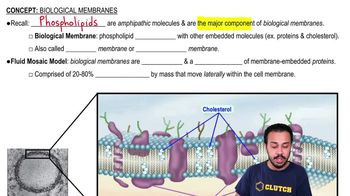
Biological Membranes Example 1
24642
views
457
rank
1
comments
06:04
Biological Membranes
33781
views
685
rank
2
comments
이 집합의 용어 (20)
하이드의 정의
What are the main components of cellular membranes?
Lipids
and
proteins
are the main components, with carbohydrates also playing an important role.
What is the structure of phospholipids in membranes?
Phospholipids are
amphipathic
molecules with hydrophilic heads and hydrophobic tails, forming a bilayer.
Describe the fluid mosaic model of membrane structure.
Membranes are a mosaic of protein molecules bobbing in a fluid bilayer of phospholipids, with proteins often grouped by function.
How do temperature and lipid composition affect membrane fluidity?
Membranes rich in
unsaturated fatty acids
are more fluid; cooling causes membranes to solidify depending on lipid types.
What role does cholesterol play in membrane fluidity?
Cholesterol reduces fluidity at moderate temperatures and prevents solidification at low temperatures by disrupting packing.
What are the two major types of membrane proteins?
Peripheral proteins
are bound to the membrane surface;
integral proteins
penetrate the hydrophobic core.
What are transmembrane proteins?
Integral proteins that span the entire membrane, often with hydrophobic α helices embedded in the bilayer.
List six functions of cell-surface membrane proteins.
Transport, enzymatic activity, signal transduction, cell-cell recognition, intercellular joining, and attachment to cytoskeleton/ECM.
How do membrane carbohydrates contribute to cell recognition?
Carbohydrates bonded to lipids (glycolipids) or proteins (glycoproteins) serve as diverse markers for cell identification.
What is selective permeability in membranes?
Membranes allow some substances to cross more easily than others, regulating molecular traffic.
How do hydrophobic and hydrophilic molecules cross the lipid bilayer?
Hydrophobic molecules pass rapidly through the bilayer; hydrophilic molecules cross slowly or require transport proteins.
What are the two types of transport proteins?
Channel proteins
provide hydrophilic tunnels;
carrier proteins
bind and shuttle molecules across membranes.
What is the function of aquaporins?
Aquaporins are channel proteins that greatly increase water molecule passage through membranes.
Define diffusion in the context of membranes.
Diffusion is the movement of particles spreading evenly, moving down their concentration gradient without energy input.
What is passive transport?
The diffusion of substances across membranes without energy expenditure, driven by concentration gradients.
Explain osmosis.
Osmosis is the diffusion of free water across a selectively permeable membrane from low to high solute concentration.
What is tonicity and how does it affect cells without cell walls?
Tonicity is the ability of a solution to cause water movement; it affects cell volume by water gain or loss.
What happens to a cell in an isotonic solution?
Water diffuses equally in both directions; cell volume remains stable.
What happens to a cell in a hypertonic solution?
Water leaves the cell, causing it to shrivel and possibly die.
What happens to a cell in a hypotonic solution?
Water enters the cell, causing it to swell and potentially burst (lyse).
 뒤로뒤로
 02:21