 뒤로
metabolism
 02:17

이 집합의 용어 (20)
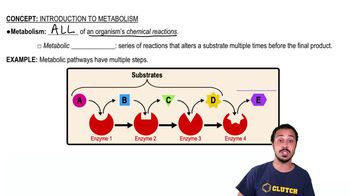
Metabolism is the totality of an organism's chemical reactions, including catabolism and anabolism, managing the material and energy resources of the cell.
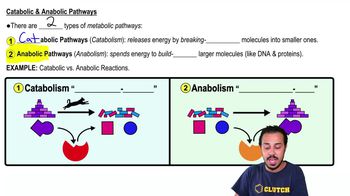
Catabolic pathways break down complex molecules into simpler ones, releasing energy. Anabolic pathways build complex molecules from simpler ones, consuming energy.
Enzymes are macromolecules that act as catalysts, speeding up chemical reactions without being consumed.
Bioenergetics is the study of how organisms manage their energy resources.
Kinetic energy is energy of motion. Potential energy is stored energy due to position or structure, such as chemical energy in bonds.
The First Law states energy can be transferred or transformed but cannot be created or destroyed (conservation of energy).
The Second Law states every energy transfer increases entropy (disorder). Living cells convert organized energy to heat, increasing universe entropy.
Free energy is the portion of a system's energy that can perform work. Changes in free energy (∆G) determine if a reaction is spontaneous.
A reaction is spontaneous if ∆G < 0, meaning it releases free energy and can perform work.
∆G = ∆H − T∆S, where ∆H is enthalpy change, T is temperature in Kelvin, and ∆S is entropy change.
Exergonic reactions release energy (∆G < 0) and are spontaneous. Endergonic reactions require energy input (∆G > 0) and are nonspontaneous.
Cells are open systems with constant material flow, preventing equilibrium, which is a state of maximum stability and no work.
ATP (adenosine triphosphate) consists of ribose sugar, adenine base, and three phosphate groups; it is the cell's energy shuttle.
Breaking the terminal phosphate bond by hydrolysis releases energy as ATP converts to ADP and inorganic phosphate (Pi), with ∆G = −7.3 kcal/mol.
Energy from ATP hydrolysis powers chemical, transport, and mechanical work by coupling exergonic ATP breakdown to endergonic processes.
Phosphorylation transfers a phosphate group from ATP to a reactant, forming a phosphorylated intermediate that is more reactive.
ATP hydrolysis changes protein shapes, enabling transport proteins to move solutes and motor proteins to move vesicles along cytoskeletal tracks.
ATP is regenerated by adding a phosphate to ADP using energy from catabolic reactions, maintaining a rapid ATP cycle in cells.
Energy coupling uses energy released from exergonic reactions to drive endergonic reactions, often mediated by ATP.
Catabolism releases energy to phosphorylate ADP to ATP; ATP then provides energy for anabolic reactions, with heat released in both processes.