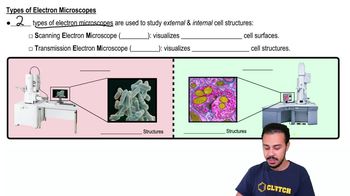
Resolution is the ability of the microscope to distinguish details, defined as the minimum distance at which two distinct points on a specimen can still be seen.
How is total magnification calculated in a light microscope?
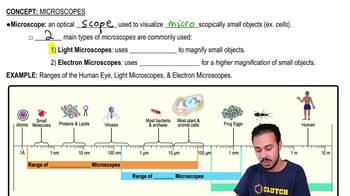
Total magnification is the product of the magnification of the ocular lens and the objective lens, e.g., 10x ocular lens × 40x objective lens = 400x total magnification.
What happens to the field of view as magnification increases?
As magnification increases, the field of view decreases, meaning less area of the slide is visible through the eyepiece.
Define working distance in microscopy.
Working distance is the distance between the slide on the stage and the tip of the objective lens; it decreases as magnification increases.
Why should the coarse adjustment knob not be used beyond the 4x objective?
Using the coarse adjustment knob beyond 4x risks damaging the slide or lens because the working distance is very small at higher magnifications.
What is the correct method to prepare a wet mount slide?
Place one drop of water on the slide, add the specimen, then carefully lower a cover slip at an angle to avoid air bubbles.
What is the purpose of using a wet mount in microscopy?
Wet mounts allow observation of living specimens in water, preserving natural movement and structure.
How can you determine which piece of hair is on top in a crossed hair wet mount?
Use the fine adjustment knob to focus through the depth of the crossed hairs; the piece that comes into focus first is on top.
What are the main differences between plant and animal cells?
Plant cells have a cell wall, chloroplasts, and large central vacuoles; animal cells lack these but have lysosomes.
What is the function of the nucleus in a eukaryotic cell?
The nucleus contains DNA and is the site of RNA transcription.
What role does the nucleolus play in the cell?
The nucleolus is the darker region in the nucleus responsible for synthesizing ribosomal RNA (rRNA).
What is the function of ribosomes?
Ribosomes are the site of protein synthesis, directed by DNA, and found in all cells.
Describe the smooth endoplasmic reticulum (smooth ER).
The smooth ER synthesizes lipids and processes newly synthesized proteins.
What is the function of the rough endoplasmic reticulum (rough ER)?
The rough ER has ribosomes and processes newly synthesized proteins.
What is the role of mitochondria in the cell?
Mitochondria are the powerhouse of the cell, producing ATP through oxidative phosphorylation.
What is the function of chloroplasts in plant cells?
Chloroplasts convert light energy into chemical energy via photosynthesis.
What is the Golgi apparatus responsible for?
The Golgi apparatus modifies, sorts, and packages proteins for shipping within or outside the cell.
What is the function of lysosomes?
Lysosomes contain enzymes that digest cellular waste and debris.
What is the plasma membrane's role?
The plasma membrane is a phospholipid bilayer that controls what enters and exits the cell.
What is cytoplasm?
Cytoplasm is the semi-fluid substance inside the cell that contains organelles.
 뒤로
 06:35