 뒤로
Nucleic Acids and RNA World - General Biology
 01:05

이 집합의 용어 (35)
What is a nucleic acid?
Nucleic acid is a polymer of nucleotide monomers, each consisting of a phosphate group, a five-carbon sugar, and a nitrogenous base.
Phosphate group, five-carbon sugar, and nitrogenous base.
Ribonucleotides are monomers of RNA, and have ribose sugar with an -OH group at 2′ carbon
deoxyribonucleotides are monomers of DNA, and have deoxyribose sugar with H at 2′ carbon.
Both sugars have -OH group bonded to 3' carbon
The two groups of nitrogenous bases:
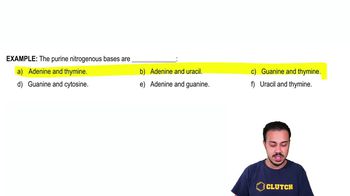
Purines have two rings (adenine, guanine)
Pyrimidines have one ring (contain 6 atoms in their one ring - cytosine, uracil in RNA, thymine in DNA - "CUT of Py")
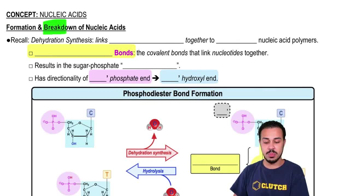
Via condensation reactions, forming phosphodiester linkages between the phosphate group on the 5' carbon of one nucleotide and the 3′ OH of another.
Produces DNA polymers or RNA polymers
They have 2 diff ends: the 5′ end has unlinked phosphate grp, the 3′ end has unlinked hydroxyl grp (-OH), so the strand runs 5′ → 3'
U only read it 1 way
If have, 5′ — A T T A G C — 3′, its not same backwards, 5′ — C G A T T A — 3′
5' , 3'--> unlinked phos., hydroxyl
A T T A G C - nitrog. bases
Activated nucleotides (nucleoside triphosphates) provide energy; energy is released when 2 phosphates are removed during polymerization.
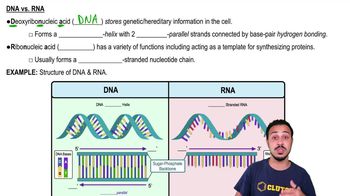
DNA forms an antiparallel double helix with complementary base pairing (A-T, C-G) held by hydrogen bonds, with a sugar-phosphate backbone.
*Antiparallel - parallel to each other but pointing in opposite directions; ex: ↑ ↓
What causes the DNA strands to twist into a helix? What stabilizes the helix?
Hydrophobic interactions - hydrophobic bases hide from water in the cell by stacking inside DNA, with the phosphate group on the outside
Van der Waals interactions stabilize strands.
What is the tertiary structure of DNA? Two forms?
DNA forms more compact, three-dimensional structures in cells.
Forms supercoils - wound too tightly or loosely
Wraps around DNA-binding histone proteins
Information is stored in the sequence of nucleotide nitrogenous bases, which function like letters in an alphabet.
Strands separate by breaking hydrogen bonds.
The original strands stay in place, while free nucleotides floating around the cell find and pair with their matching bases (A–T, C–G).
Phosphodiester bonds form to create a complementary strand
RNA contains ribose sugar instead of deoxibrose, uracil instead of thymine, and has a reactive 2′-OH group making it less stable than DNA (-H group).
RNA folds back on itself → complementary bases pair (A–U, G–C) → hydrogen bonds form between the bases → creates a hairpin structure. The paired sections are antiparallel, meaning they run in opposite directions (5′→3′ and 3′→5′).
Complex 3D shapes formed by folding of secondary structures, allowing diverse size, shape, and reactivity.
What are some types of RNA? What roles do they play?
mRNA, rRNA and tRNA are key in protein synthesis.
RNA folds into various complex shapes (different than DNA's structure - always a helix), regulates mRNA production, and can catalyze chemical reactions.
RNA molecules with catalytic activity and have active sites that can catalyze phosphodiester bond formation and potentially self-replicate.
Proposes early life used RNA both to store genetic information and catalyze its own replication before DNA and proteins.
RNA can store information, catalyze reactions, and replicate, fulfilling key life characteristics before proteins evolved.
Energy carriers (ATP), coenzymes (NAD+), and chemical messengers (cAMP).
What did Chemical Evolution lead to?
Production of a molecule that could self replicate
What does DNA do? How does it replicate?
Stores genetic information
Replicated using proteins
What is the RNA world hypothesis?
Proposes time in evolution where RNA both stored genetic information and catalyzed its own replication
What are the phosphate group and nitrogenous base bonded to in a nucelotide?
A 5-carbon sugar molecule
What is a condensation reaction?
A chemical process where two smaller molecules (monomers) join together to form a larger molecule, releasing a water molecule as a byproduct
What does it mean if a group is unlinked in a molecule?
"Unlinked" means the molecule has a free group at the end that isn't connected to another nucleotide.
Ex: 5' phosphate group in the sugar-phosphate backbone of a DNA or RNA strand is unlinked bc its at the end and isnt connected to another nucleotide.
Nucleoside vs. Nucleotide
Nucleoside = sugar + nitrogenous base (3 phosphates needed to polymerize - provide energy, releases 2 P in reaction)
Nucleotide = S + NB + ≥1 P (needs 2 P )
Nucleotide disphosphate = S + NB + 2 P (needs 1 P)
Nucleotide triphosphate = S + NB + 3 P (Activated; no P needed for energy --> can react)
What did Watson and Crick determine about DNA?
DNA has 2 antiparallel strands with A–T & C–G base pairing; H-bonds hold them together, forming a double helix with the sugar-phosphate backbone outside and bases inside.
What are van der waals interactions? When do they usually occur?
Weak attractions between nearby atoms caused by temporary charges.
occur when atoms/molecules are very close together, especially between nonpolar molecules or hydrophobic groups
What is complimentary base pairing? What does it allow for?
Where bases pair with their specific match: A–T and C–G
Complementary base pairing allows each strand to be copied exactly producing two identical daughter molecules
What makes the DNA double helix stable?
Phosphodiester bonds, hydrogen bonds, and hydrophobic interactions --> make it good for storing genetic information, bc their stability prevents DNA from breaking down.
What is the theory of chemical evolution?
Life may have started as a free RNA molecule in water, not enclosed by a membrane. To reproduce, it needed to provide a template and build a copy using monomers. RNA can do both → so scientists propose that early life may have been made of RNA.
Why does RNA possibly preceed proteins?
Most modern ribozymes aid protein production, if removed, proteins could not be made
Nucleotide functions?
Energy carriers - ATP
Coenzymes (NAD+)
Chemical messengers (cAMP)
Building blocks for nucleic acids