 뒤로
Nucleic Acids and the RNA World
 01:05

이 집합의 용어 (20)
Nucleic acids are biomolecules that store and transmit genetic information, including DNA and RNA.
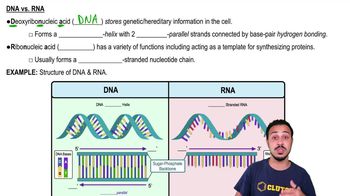
The two main types are DNA (deoxyribonucleic acid) and RNA (ribonucleic acid).
A nucleotide consists of a sugar, a phosphate group, and a nitrogenous base.
Deoxyribose is the sugar in DNA nucleotides.
Ribose is the sugar in RNA nucleotides.
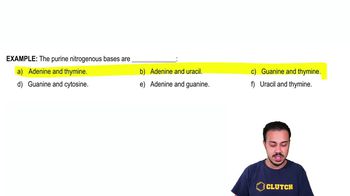
Adenine (A), Thymine (T), Cytosine (C), and Guanine (G).
Adenine (A), Uracil (U), Cytosine (C), and Guanine (G).
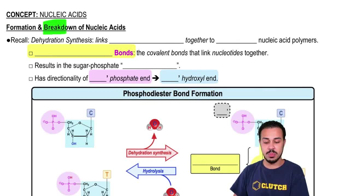
Nucleotides link via phosphodiester bonds between the phosphate of one nucleotide and the sugar of the next.
Nucleic acid strands have a 5' to 3' direction based on the sugar-phosphate backbone.
The RNA World hypothesis suggests early life used RNA for both genetic information and catalysis before DNA and proteins.
RNA can act as a ribozymes, catalyzing chemical reactions, supporting its role in early life.
DNA is more stable due to deoxyribose and double-stranded structure; RNA is less stable and usually single-stranded.
RNA functions in protein synthesis (mRNA, tRNA, rRNA) and regulation of gene expression.
A ribozyme is an RNA molecule with catalytic activity.
A pairs with T via two hydrogen bonds, and C pairs with G via three hydrogen bonds.
The 3D structure, like the double helix in DNA, is crucial for stability and function.
mRNA carries genetic information from DNA to ribosomes for protein synthesis.
tRNA brings amino acids to ribosomes during protein synthesis.
rRNA is a structural and catalytic component of ribosomes.
It proposes that self-replicating RNA molecules were precursors to current life forms, combining genetic and catalytic roles.