 뒤로
Origins of Life and Endosymbiosis in General Biology
 03:23

이 집합의 용어 (20)
Earth formed about 4.6 billion years ago. The environment was hostile until 3.9 bya, and the earliest fossil evidence of life dates to 3.5 bya.
Primitive Earth had inorganic precursors, free energy, and lacked significant atmospheric oxygen, allowing organic molecules to form.
Organic molecules could have formed abiotically on Earth or been delivered by meteorites.
Life arose gradually from inorganic molecules in a reducing atmosphere, forming organic building blocks like amino acids.
Simulated early Earth conditions and produced organic compounds such as amino acids and adenine, supporting abiotic synthesis.
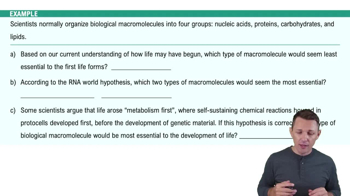
RNA was likely the first genetic material because it can store information, self-replicate, and catalyze reactions.
About 2.5 billion years ago, photosynthesizing cyanobacteria increased oxygen, killing many anaerobic organisms and changing the atmosphere.
Eukaryotic cells evolved when ancestral cells engulfed aerobic and photosynthetic bacteria, which became mitochondria and chloroplasts.
Mitochondria and chloroplasts have double membranes, their own circular DNA, and reproduce independently.
Mitochondria perform aerobic respiration, chloroplasts perform photosynthesis, both essential for eukaryotic cell energy.
Internal membranes create micro-environments allowing specialization and increased cellular efficiency.
Life originated 3.5–4.0 bya; prokaryotes dominated until 2.0 bya; oxygen accumulated 2.7 bya enabling aerobic respiration.
Life was created by a supernatural force; this is not testable and not considered a scientific hypothesis.
Organic molecules came from comets or meteorites; this hypothesis is testable.
Life evolved spontaneously from inorganic molecules on early Earth; this is testable.
Early atmosphere contained H2O, CO2, N2, NOx, H2, NH3, CH4, H2S with no free oxygen.
Lightning, UV radiation, and volcanic activity provided energy to drive chemical reactions forming organic molecules.
Early cell-like structures with membranes that separated internal chemistry from the environment, enabling metabolism and reproduction.
Proposed and popularized the endosymbiotic theory explaining the origin of mitochondria and chloroplasts.
Evidence of oxygen accumulation in the atmosphere from photosynthetic bacteria rusting iron in ancient rocks.