Skip to main content
General Biology
나의 코스
배우기
시험 준비
AI 튜터
학습 가이드
교과서적 해결책
플래시카드
탐험해 보세요
앱을 사용해 보세요
나의 코스
배우기
시험 준비
AI 튜터
학습 가이드
교과서적 해결책
플래시카드
탐험해 보세요
앱을 사용해 보세요
뒤로
Pearson Q's 7-12
카드를 뒤집기 위해 탭할 수 있습니다.
Plasma membrane's basic structure
카드를 뒤집기 위해 탭할 수 있습니다.
👆
Plasma membrane's basic structure
A
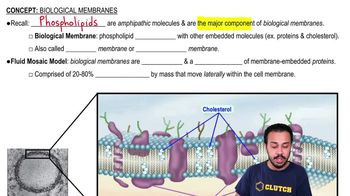
phospholipid bilayer
containing membrane proteins.
진행 상황 추적
컨트롤 버튼이 '내비게이션' 모드로 변경되었습니다.
1/90
추천 영상
02:21
Biological Membranes Example 1
24638
views
457
rank
1
comments
06:04
Biological Membranes
33774
views
685
rank
2
comments
이 집합의 용어 (90)
하이드의 정의
Plasma membrane's basic structure
A
phospholipid bilayer
containing membrane proteins.
Hydrophilic vs. hydrophobic phospholipid regions
Heads are
hydrophilic
; fatty-acid tails are
hydrophobic
.
Membrane model describing proteins in lipid bilayer
The
fluid mosaic model
.
Role of cholesterol in animal cell membranes
Buffers membrane
fluidity
across temperature changes.
Function of membrane carbohydrates
Cell
recognition
and cell-to-cell interactions.
Transport protein specificity determined by
Its
shape
and chemical properties matching particular solutes.
Molecules crossing lipid bilayer most easily
Small
nonpolar molecules
such as O2 and CO2.
Definition of passive transport
Movement down a gradient
without cellular energy
.
Definition of active transport
Energy-driven movement
against a concentration gradient
.
Facilitated diffusion
Passive transport through a
membrane protein
.
Osmosis
Diffusion of
water
across a selectively permeable membrane.
Direction of water movement during osmosis
Water moves toward the side with the
higher solute concentration
.
Effect of hypertonic solution on animal cells
Cell
loses water and shrivels
.
Effect of hypotonic solution on animal cells
Cell
gains water, swells, and may lyse
.
Effect of hypotonic solution on plant cells
Cell becomes
turgid
; cell wall prevents bursting.
Plasmolysis
Water loss causes the plant membrane to
pull from the cell wall
.
Cotransport
One solute's gradient drives transport of
another solute
.
How Ca2+ remains lower inside cells
Active transport pumps Ca2+
against its gradient
.
Aquaporins
Membrane channel proteins that rapidly transport
water
.
Phagocytosis
Endocytosis where a cell
engulfs a large particle
.
First law of thermodynamics
Energy is
conserved
; it can be transferred or transformed.
Second law of thermodynamics
Energy transformations increase the universe's
entropy
.
Meaning of negative ΔG
Reaction is
exergonic
and thermodynamically spontaneous.
Meaning of positive ΔG
Reaction is
endergonic
and requires free-energy input.
ΔG at equilibrium
Zero; there is
no net change
.
Products of ATP hydrolysis
ADP + Pi and
released free energy
.
Phosphorylation
Transfer of a
phosphate group
to another molecule.
How ATP drives endergonic reactions
By
coupling ATP hydrolysis
to the reaction.
What enzymes lower
Activation energy
.
Do enzymes change reaction ΔG?
No; they change reaction
rate
, not ΔG.
Enzyme's active site
Region where
substrate binds
and catalysis occurs.
Induced fit
Substrate binding causes enzyme to
change shape
.
Competitive inhibitor binding site
Binds at the enzyme's
active site
.
Allosteric inhibitor binding site
Binds at a site
other than the active site
.
Effect of enzyme substrate saturation
Reaction rate reaches its
maximum
for that enzyme amount.
How to increase rate of saturated enzyme reaction
Add more
enzyme
.
Feedback inhibition
A pathway's
end product inhibits
an earlier enzyme.
First stage of cellular respiration
Glycolysis.
Location of glycolysis
The
cytosol
.
Glycolysis products per glucose
2 pyruvate, 2 NADH, and net 2 ATP.
What happens to pyruvate before citric acid cycle
It is oxidized to
acetyl-CoA
.
Citric acid cycle location in eukaryotes
The
mitochondrial matrix
.
Products from one acetyl-CoA in citric acid cycle
3 NADH, 1 FADH2, 1 ATP/GTP, and 2 CO2.
Role of NADH and FADH2 in ETC
Deliver
high-energy electrons
.
Location of mitochondrial electron transport chain
The
inner mitochondrial membrane
.
Where mitochondrial ETC pumps H+
From the matrix into the
intermembrane space
.
Final electron acceptor in aerobic respiration
Oxygen (
O2
).
What forms when O2 accepts electrons and H+
Water (
H2O
).
What powers ATP synthase
H+ flowing down its
electrochemical gradient
.
Chemiosmosis
Using an
H+ gradient
to drive ATP synthesis.
Substrate-level phosphorylation
Direct enzyme transfer of phosphate to
ADP
.
Where substrate-level phosphorylation occurs
Glycolysis and the
citric acid cycle
.
Oxidative phosphorylation
ATP production through electron transport and
chemiosmosis
.
Why fermentation regenerates NAD+
So glycolysis can continue
without oxygen
.
Where photosynthesis light reactions occur
The
thylakoid membranes
.
Where Calvin cycle occurs
The
chloroplast stroma
.
Products of light reactions
ATP, NADPH, and O2.
Source of photosynthetic O2
Water (
H2O
).
What happens when chlorophyll absorbs a photon
An electron is
excited to a higher energy level
.
Electron replacement in photosystem II
Electrons come from
split water molecules
.
Path of linear photosynthetic electron flow
H2O → PSII → ETC → PSI → NADPH.
Where H+ accumulates during light reactions
The
thylakoid space (lumen)
.
What Calvin cycle consumes
CO2, ATP, and NADPH.
Calvin cycle's direct sugar product
G3P.
Three phases of Calvin cycle
Fixation, reduction, and RuBP regeneration.
Function of rubisco
Catalyzes attachment of CO2 to RuBP.
Photorespiration
Rubisco uses O2 instead of CO2, wasting energy.
How C4 plants reduce photorespiration
Spatially concentrate CO2 around rubisco.
How CAM plants conserve water
Open stomata at night and store fixed carbon.
When CAM plants open stomata
At night.
Molecule oxidized during photosynthesis
Water (H2O).
Molecule reduced during photosynthesis
CO2.
Light colors most effective for photosynthesis
Red and blue/violet.
Visible color least absorbed by chlorophyll
Green.
Phase following G1 in cell cycle
S phase.
What occurs during S phase
DNA replication.
Phase immediately after S phase
G2.
G0 phase
A
nondividing state
outside the active cell cycle.
Chromatin composition
DNA and associated proteins.
Duplicated chromosome composition
Two sister chromatids.
Where sister chromatids are most closely attached
The
centromere
.
Chromosome behavior during prophase
They
condense
.
Metaphase characteristic
Chromosomes align at the
metaphase plate
.
Anaphase event
Sister chromatids separate and move to opposite poles.
Telophase event
New nuclei form and chromosomes begin
decondensing
.
Primary role of mitotic spindle
Separating duplicated chromosomes.
Animal-cell cytokinesis
A
cleavage furrow
pinches the cell in two.
Plant-cell cytokinesis
Vesicles form a
cell plate
between daughter cells.
Components forming active MPF
Cyclin and Cdk.
Feature shared by all cancers
Escape from normal
cell-cycle controls
.
 뒤로뒤로
 02:21