Skip to main content
General Biology
나의 코스
배우기
시험 준비
AI 튜터
학습 가이드
교과서적 해결책
플래시카드
탐험해 보세요
앱을 사용해 보세요
나의 코스
배우기
시험 준비
AI 튜터
학습 가이드
교과서적 해결책
플래시카드
탐험해 보세요
앱을 사용해 보세요
뒤로
Photosynthesis and Calvin Cycle - General Biology
카드를 뒤집기 위해 탭할 수 있습니다.
How do the light reactions help make glucose?
카드를 뒤집기 위해 탭할 수 있습니다.
👆
How do the light reactions help make glucose?
Light reactions convert light energy into chemical energy (ATP and NADPH), which are used in the Calvin Cycle to synthesize glucose.
진행 상황 추적
컨트롤 버튼이 '내비게이션' 모드로 변경되었습니다.
1/20
추천 영상
01:48
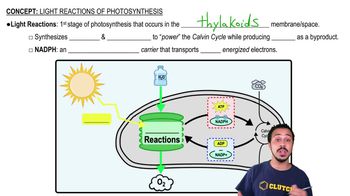
Light Reactions of Photosynthesis Example 1
12633
views
153
rank
04:06
Light Reactions of Photosynthesis
16825
views
206
rank
15:15
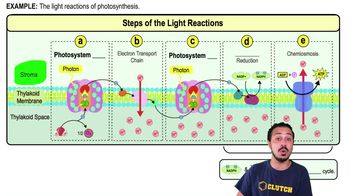
Steps of the Light Reactions
16512
views
201
rank
이 집합의 용어 (20)
하이드의 정의
How do the light reactions help make glucose?
Light reactions convert light energy into chemical energy (ATP and NADPH), which are used in the Calvin Cycle to synthesize glucose.
What molecule is the electron donor in light reactions?
Water (H2O)
is the electron donor, releasing electrons, protons, and oxygen.
What molecule is the final electron acceptor in light reactions?
NADP+
is the final electron acceptor, forming NADPH.
How is ATP synthase in chloroplasts similar to ATP synthase in mitochondria?
Both use a proton gradient across a membrane to drive ATP synthesis from ADP and Pi.
Examples of active and passive transport in light reactions?
Active transport: Proton pumping into thylakoid space. Passive transport: Protons flow back through ATP synthase.
Two similarities between light reactions and oxidative phosphorylation?
Both use electron transport chains and proton gradients to produce ATP.
Two differences between light reactions and oxidative phosphorylation?
Light reactions use light energy and water as electron donor; oxidative phosphorylation uses chemical energy and organic molecules.
What are the 3 substrates of the Calvin Cycle?
CO2, Ribulose-1,5-bisphosphate (RuBP), and ATP/NADPH.
What are the 3 products of the Calvin Cycle?
Glyceraldehyde-3-phosphate (G3P), ADP, and NADP+.
Which substrate is reduced in the Calvin Cycle?
3-Phosphoglycerate (3-PGA)
is reduced to G3P.
Which substrate is oxidized in the Calvin Cycle?
NADPH is oxidized to NADP+.
What makes the Calvin Cycle an enzymatic cycle?
It regenerates its starting molecule RuBP through enzyme-catalyzed reactions.
What does it mean to 'fix' carbon in photosynthesis?
Converting inorganic CO2 into an organic molecule by attaching it to RuBP.
Which enzyme is responsible for fixing carbon?
Rubisco
catalyzes the fixation of CO2 to RuBP.
Similarities between Calvin Cycle and Citric Acid Cycle?
Both are cyclic, involve enzyme-catalyzed steps, and regenerate starting molecules.
Differences in molecules reduced vs. oxidized in Calvin vs. Citric Acid Cycle?
Calvin Cycle reduces CO2 to sugar; Citric Acid Cycle oxidizes acetyl CoA to CO2.
Is ATP made or used in Calvin Cycle and Citric Acid Cycle?
Calvin Cycle uses ATP; Citric Acid Cycle produces ATP.
What is the energy source for Calvin Cycle vs. Citric Acid Cycle?
Calvin Cycle uses ATP and NADPH from light reactions; Citric Acid Cycle uses chemical energy from acetyl CoA.
What is the role of NADPH in photosynthesis?
NADPH donates electrons and hydrogen for the reduction of 3-PGA to G3P in the Calvin Cycle.
What is the significance of the proton gradient in the thylakoid membrane?
It drives ATP synthesis by ATP synthase during light reactions.
 뒤로뒤로
 01:48