 뒤로
Photosynthesis and Chloroplast Function in General Biology
 03:32

이 집합의 용어 (20)
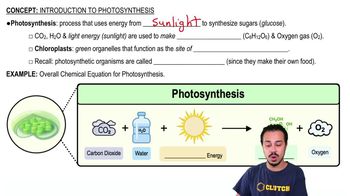
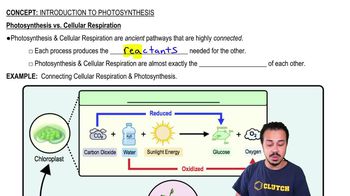
Photosynthesis is the process by which solar energy is converted into chemical energy in organic molecules, primarily glucose, providing energy and organic matter for most living organisms.
Autotrophs produce their own food from inorganic substances. Types: Chemoautotrophs use inorganic compounds for energy; Photoautotrophs use light energy to convert CO2 into organic molecules.
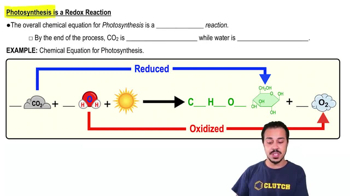
\(6\ CO_2+6\ H_2O+Light\ Energy\rightarrow C_6H_{12}O_6+6\ O_2\)
Water is oxidized to O2 (loses electrons), and CO2 is reduced to glucose (gains electrons).
Photosynthesis mainly occurs in leaves, specifically in the mesophyll cells containing many chloroplasts.
Chlorophyll is the green pigment in chloroplasts that absorbs light energy to drive photosynthesis.
Stomata are microscopic pores in leaves that allow gas exchange: CO2 enters and O2 exits.
Chloroplasts have outer and inner membranes, contain stacks of thylakoids (grana), and a fluid-filled stroma where the Calvin cycle occurs.
1) Light Reactions in thylakoids produce ATP, NADPH, and O2.
2) Calvin Cycle in stroma uses ATP and NADPH to form sugars from CO2.
Sunlight is electromagnetic energy composed of photons; wavelength determines the type of radiation absorbed by pigments.
Chlorophyll a initiates light reactions; chlorophyll b and carotenoids are accessory pigments that broaden light absorption.
Leaves appear green because chlorophyll reflects green light and absorbs mainly blue and red wavelengths.
It showed photosynthesis is most efficient at blue and red wavelengths by observing bacteria clustering where oxygen was produced.
Light excites electrons in photosystems, water is split releasing O2, and ATP and NADPH are produced via electron transport and chemiosmosis.
Photosystem II splits water and initiates electron transport; Photosystem I transfers electrons to NADP+ to form NADPH.
ATP is produced by ATP synthase using a proton gradient created by electron transport across the thylakoid membrane (chemiosmosis).
1) Carbon fixation: CO2 attaches to RuBP.
2) Reduction: ATP and NADPH convert 3-PGA to G3P.
3) Regeneration: RuBP is regenerated using ATP.
G3P can be used to synthesize glucose, fatty acids, amino acids, and other organic molecules.
C4 plants fix CO2 into a 4-carbon compound spatially to reduce photorespiration.
CAM plants fix CO2 at night temporally to conserve water in hot, dry environments.
Phytoplankton produce 50-85% of the world’s oxygen and form the base of aquatic food webs.