 뒤로
Photosynthesis and Related Concepts in General Biology
 03:32

이 집합의 용어 (20)
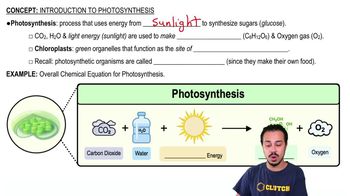
Photoautotrophs are organisms like plants, algae, and some protists and bacteria that produce their own food using light energy through photosynthesis.
Chlorophyll is a light-absorbing pigment in chloroplasts that converts solar energy into chemical energy during photosynthesis.
Photosynthesis occurs in chloroplasts, which have a double membrane, stacks of thylakoids, and a fluid called stroma.
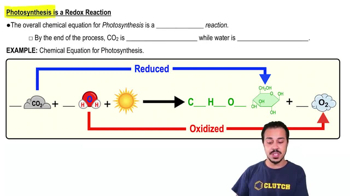
Oxygen produced in photosynthesis comes from water (H2O), not carbon dioxide (CO2), as shown by experiments using oxygen isotope O-18.
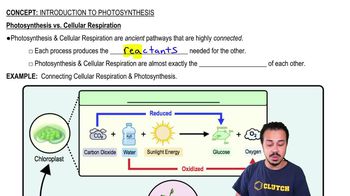
Photosynthesis is a redox process where water is oxidized and carbon dioxide is reduced to form glucose.
The two stages are the light reactions (in thylakoids) producing ATP and NADPH, and the Calvin cycle (in stroma) that fixes CO2 into sugars.
Carbon fixation is the process in the Calvin cycle where CO2 is incorporated into organic molecules.
Chlorophyll absorbs mainly blue and red light, while green light is least effective for photosynthesis.
Carotenoids protect chlorophyll from damage by excessive light through photoprotection.
Photosystems are complexes of light-harvesting pigments and proteins that capture solar energy and transfer electrons.
Two photosystems work together to transfer electrons from water to NADP+, requiring two photons to drive the electron transport chain and produce ATP and NADPH.
ATP is made by photophosphorylation, where an electron transport chain pumps H+ into the thylakoid space, and H+ flows back through ATP synthase.
The Calvin cycle includes carbon fixation, reduction, release of G3P, and regeneration of RuBP.
The Calvin cycle uses ATP for energy and NADPH for electrons to reduce CO2 into sugar molecules.
They use different mechanisms to capture and use CO2 efficiently under various environmental conditions to reduce photorespiration.
About 50% of carbohydrates produced by photosynthesis are used by plant mitochondria for cellular respiration.
Sugars serve as starting materials for making proteins, lipids, and cellulose, which forms plant cell walls.
The greenhouse effect is the warming of Earth’s atmosphere caused by gases like CO2 trapping heat.
Reducing fossil fuel use and deforestation can lower greenhouse gas emissions, helping to moderate global warming and climate change.
Photosynthesis provides food and oxygen, supporting almost all living organisms and maintaining Earth's ecosystems.