 뒤로
Photosynthesis in General Biology
 03:32

이 집합의 용어 (20)
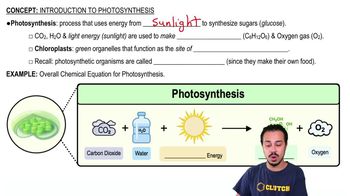
Photosynthesis is the process by which plants, algae, and some prokaryotes convert solar energy into chemical energy, producing organic molecules from CO2 and H2O.
Autotrophs produce their own food from inorganic substances using sunlight. Heterotrophs obtain organic molecules by consuming other organisms and depend on autotrophs for food and oxygen.
Photosynthesis occurs mainly in the chloroplasts of leaf mesophyll cells, specifically within the thylakoids and stroma.
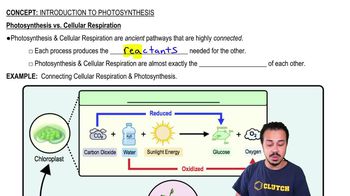
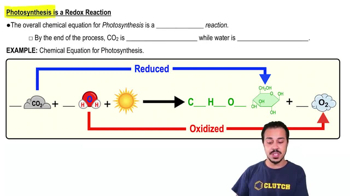
CO2 + H2O + light energy → C6H12O6 + O2. CO2 is reduced to sugar, and H2O is oxidized to O2 in this endergonic redox process.
Light reactions convert solar energy to ATP and NADPH and release O2. The Calvin cycle uses ATP and NADPH to fix CO2 into sugars.
Photosynthesis uses visible light (380–740 nm). Chlorophyll absorbs violet-blue and red light, reflecting green, which is why leaves appear green.
Chlorophyll a is the main pigment absorbing light. Chlorophyll b and carotenoids are accessory pigments that broaden the absorption spectrum and provide photoprotection.
Electrons in chlorophyll are excited to a higher energy state. In isolation, this energy is released as heat or fluorescence.
A photosystem consists of a reaction-center complex and light-harvesting complexes. There are two types: Photosystem II (P680) and Photosystem I (P700).
Electrons flow from water through Photosystem II and I, producing ATP, NADPH, and releasing O2 by splitting water.
Electrons cycle back to Photosystem I, producing ATP but not NADPH or O2, providing extra ATP and protecting cells from light damage.
ATP is produced by chemiosmosis, where a proton gradient across the thylakoid membrane drives ATP synthase to convert ADP and Pi into ATP.
1. Carbon fixation: CO2 attaches to RuBP by rubisco.
2. Reduction: ATP and NADPH convert 3-phosphoglycerate to G3P.
3. Regeneration: Some G3P regenerates RuBP.
Rubisco catalyzes the attachment of CO2 to RuBP during carbon fixation.
Photorespiration occurs when rubisco binds O2 instead of CO2, reducing photosynthetic efficiency.
C4 plants fix CO2 into a four-carbon compound in mesophyll cells using PEP carboxylase, which is transported to bundle-sheath cells for the Calvin cycle, reducing photorespiration.
CAM plants open stomata at night to fix CO2 into organic acids, releasing CO2 during the day for the Calvin cycle, conserving water in arid conditions.
Photosynthesis provides energy and organic molecules for most life, stores excess sugar as starch, and supplies carbon skeletons for biosynthesis.
C3 uses rubisco and is efficient in cool, moist conditions. C4 uses PEP carboxylase with spatial separation to minimize photorespiration. CAM uses temporal separation, fixing CO2 at night.
Stomata are pores that allow gas exchange: CO2 enters and O2 exits the leaf.