 뒤로
Photosynthesis - lecture 6a-chapter 10(exam 2)
 03:32

이 집합의 용어 (28)
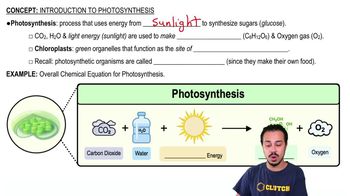
Photosynthesis is the process that converts solar energy into chemical energy within chloroplasts, nourishing almost the entire living world directly or indirectly.
Autotrophs are self-feeders that sustain themselves without eating other organisms; they produce organic molecules from CO2 and inorganic molecules.
Photoautotrophs use sunlight energy to make organic molecules; most plants, multicellular algae, and some prokaryotes are photoautotrophs.
Heterotrophs obtain organic material from other organisms and act as consumers or decomposers in the biosphere.
Most photosynthesis occurs in the leaves, specifically in the mesophyll cells where chloroplasts are abundant.
A chloroplast has a double membrane envelope, a dense fluid called stroma, and a third membrane system of connected sacs called thylakoids, which may be stacked into grana.
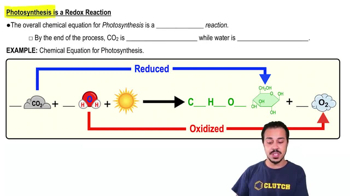
6 CO2 + 12 H2O + light energy → C6H12O6 + 6 O2 + 6 H2O
Chloroplasts split H2O into hydrogen and oxygen, incorporating electrons into sugar molecules and releasing O2 as a by-product.
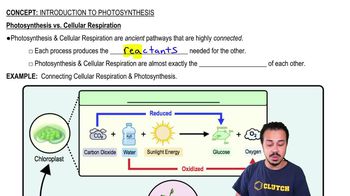
Photosynthesis oxidizes H2O and reduces CO2, reversing electron flow compared to respiration and requiring light energy.
The light reactions in the thylakoids convert light energy to ATP and NADPH, and the Calvin cycle in the stroma uses these to fix CO2 into sugar.
Light reactions split water, release O2, reduce NADP+ to NADPH, and generate ATP by photophosphorylation.
The Calvin cycle fixes CO2 into organic molecules, reduces fixed carbon to carbohydrate using NADPH, and regenerates its CO2 acceptor.
Sunlight is electromagnetic radiation with wavelengths; visible light (380–740 nm) drives photosynthesis and consists of photons with energy inversely related to wavelength.
Photosynthetic pigments absorb visible light; chlorophyll a is the key pigment, chlorophyll b and carotenoids are accessory pigments that broaden the spectrum.
They differ in one functional group: chlorophyll a has a CH3 group, chlorophyll b has a CHO group; both have a porphyrin ring with magnesium at the center.
An electron moves from ground to excited state; if isolated, it falls back releasing heat or fluorescence.
A photosystem consists of a reaction-center complex with chlorophyll a and a primary electron acceptor, surrounded by light-harvesting complexes that transfer photon energy.
Photosystem II (P680) absorbs light best at 680 nm; Photosystem I (P700) absorbs best at 700 nm; both participate in linear electron flow.
Electrons excited in PSII are replaced by splitting water, move through electron transport chain generating ATP, then re-energized in PSI to reduce NADP+ to NADPH.
Cyclic electron flow involves only PSI, electrons cycle back to PSI, generating ATP without producing NADPH or oxygen.
Both use electron transport chains to pump protons and ATP synthase to make ATP, but chloroplasts use light energy and pump protons into thylakoid space, mitochondria use chemical energy and pump into intermembrane space.
1. Carbon fixation by rubisco binding CO2 to RuBP
2. Reduction of 3-phosphoglycerate to G3P using ATP and NADPH
3. Regeneration of RuBP using ATP
One molecule of glyceraldehyde 3-phosphate (G3P) sugar is produced as net gain; six G3P molecules form but five are used to regenerate RuBP.
Photorespiration occurs when rubisco binds O2 instead of CO2, producing a two-carbon compound and reducing photosynthetic efficiency, especially in hot, dry conditions.
C4 plants fix CO2 into a four-carbon compound in mesophyll cells using PEP carboxylase, then release CO2 in bundle-sheath cells for the Calvin cycle, reducing photorespiration.
PEP carboxylase has a higher affinity for CO2 than rubisco and fixes CO2 into four-carbon compounds even at low CO2 concentrations.
CAM plants open stomata at night to fix CO2 into organic acids stored in vacuoles; stomata close during day and CO2 is released for the Calvin cycle, separating steps temporally.
C4 plants separate carbon fixation and Calvin cycle spatially in different cells; CAM plants separate these steps temporally in the same cell.