Skip to main content
General Biology
나의 코스
배우기
시험 준비
AI 튜터
학습 가이드
교과서적 해결책
플래시카드
탐험해 보세요
앱을 사용해 보세요
나의 코스
배우기
시험 준비
AI 튜터
학습 가이드
교과서적 해결책
플래시카드
탐험해 보세요
앱을 사용해 보세요
뒤로
Photosynthesis: Light Reactions and Calvin Cycle
카드를 뒤집기 위해 탭할 수 있습니다.
Where do the light reactions of photosynthesis occur?
카드를 뒤집기 위해 탭할 수 있습니다.
👆
Where do the light reactions of photosynthesis occur?
In the
thylakoid membrane
of the chloroplast.
진행 상황 추적
컨트롤 버튼이 '내비게이션' 모드로 변경되었습니다.
1/14
추천 영상
03:32
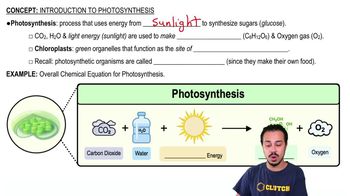
Introduction to Photosynthesis
21117
views
425
rank
07:55
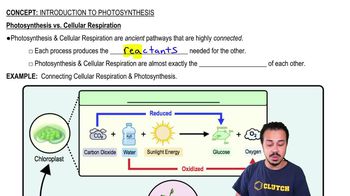
Photosynthesis vs. Cellular Respiration
16826
views
220
rank
03:20
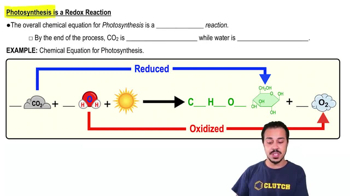
Photosynthesis is a Redox Reaction
1902
views
45
rank
이 집합의 용어 (14)
하이드의 정의
Where do the light reactions of photosynthesis occur?
In the
thylakoid membrane
of the chloroplast.
What are the main inputs and outputs of the light reactions?
Inputs:
Light energy
and
H₂O
. Outputs:
ATP
,
NADPH
, and
O₂
(by-product).
What is the role of Photosystem II in the light reactions?
Photosystem II absorbs light, energizes electrons, and splits water to replace electrons, releasing
O₂
and
H⁺
.
What happens to electrons after Photosystem II?
Electrons pass down an
electron transport chain
, pumping H⁺ into the thylakoid space.
What is the function of Photosystem I?
Photosystem I re-energizes electrons before they reduce
NADP⁺
to
NADPH
.
How is ATP produced in the light reactions?
H⁺ flows back through
ATP synthase
via chemiosmosis, producing ATP.
Where does the Calvin cycle take place?
In the
stroma
of the chloroplast.
What is the first step of the Calvin cycle?
Carbon fixation:
Rubisco
attaches CO₂ to RuBP, forming two 3-carbon 3-PGA molecules.
What happens during the reduction phase of the Calvin cycle?
ATP and NADPH convert 3-PGA into
G3P
, a 3-carbon sugar.
What is the regeneration step in the Calvin cycle?
Most G3P is rearranged, using ATP, back into RuBP so the cycle can repeat.
How many G3P molecules are produced from 3 CO₂ in the Calvin cycle?
6 G3P molecules are made; 1 G3P exits to make sugars, and 5 regenerate 3 RuBP.
What sugars are produced from G3P?
G3P is converted into
glucose
,
sucrose
, and
starch
.
What is the relationship between light reactions and the Calvin cycle?
Light reactions convert light energy into chemical energy (ATP, NADPH), which powers the Calvin cycle to store energy in organic molecules.
What is the overall chemical equation for photosynthesis?
6 CO₂ + 6 H₂O + light → C₆H₁₂O₆ + 6 O₂.
 뒤로뒤로
 03:32