 뒤로
Phylogeny and the Tree of Life - General Biology
 01:37

이 집합의 용어 (20)
Phylogeny is the evolutionary history and relationships among species or groups of species.
Phylogenetic trees are pictorial hypotheses showing evolutionary relationships and descent from common ancestors.
A system of naming species with two parts: the genus name and the species name, e.g., Panthera pardus.
Binomial names are globally recognized and less ambiguous than common names, which can vary by region and language.
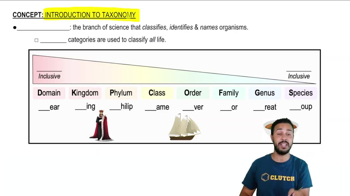
Species, Genus, Family, Order, Class, Phylum, Kingdom, Domain.
A taxon is a taxonomic group of any rank, such as species, family, or class.
All organisms are related through descent from a common ancestor and accumulate differences over generations, causing unity and diversity.
Systematics is the study of classifying organismal diversity and evolutionary relationships.
Sister taxa are groups that share an immediate common ancestor on a phylogenetic tree.
A monophyletic group contains an ancestor and all of its descendants.
Paraphyletic groups include an ancestor and some, but not all, descendants. Polyphyletic groups include distantly related species without the most recent common ancestor.
Shared ancestral characters originated in a distant ancestor; shared derived characters are evolutionary novelties unique to a particular clade.
Cladistics is an approach to build phylogenies using shared homologous characters to group related species into clades.
Homologous characters are phenotypic or genetic similarities due to shared ancestry.
Analogous characters arise from convergent evolution and similar selective pressures, not common ancestry, so they do not reflect evolutionary relationships.
Homoplasy is the presence of similar functional structures in unrelated species due to convergent evolution.
A molecular clock uses the rate of molecular changes in genes to estimate the timing of evolutionary events.
Molecular clocks are calibrated using known divergence times from the fossil record and multiple genes for accuracy.
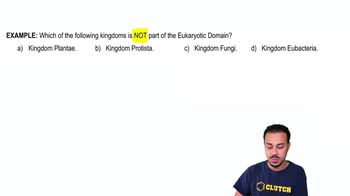
The three domains are Bacteria, Archaea, and Eukarya.
Earlier systems recognized two kingdoms (plants and animals) and later five kingdoms: Monera, Protista, Plantae, Fungi, and Animalia.