An operon is a cluster of genes transcribed as a single mRNA, containing one promoter, one transcription stop site, and multiple translation start and stop sites for each gene.
Define cis-elements and trans-acting factors in prokaryotic operons.
Cis-elements are DNA sequences like promoters and operators; trans-acting factors are proteins like repressors and activators that bind cis-elements to regulate transcription.
What is the consensus sequence in E. coli promoters?
The consensus sequence is the most common nucleotide at each position in the -35 and -10 regions, typically 5’-TTGACA (-35) and 5’-TATAAT (-10), recognized by RNA polymerase sigma factor.
How does promoter sequence affect basal gene expression in E. coli?
Promoters more similar to the consensus sequence bind RNA polymerase more efficiently, resulting in higher basal transcription initiation rates.
What are the three levels of gene expression regulation in E. coli?
Basal (default 'on'), repressed (lower than basal, negative regulation), and activated (higher than basal, positive regulation).
Describe the default state and regulation of the trp operon.
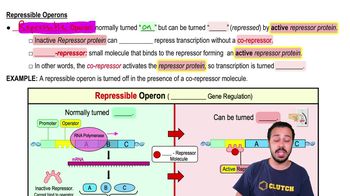
The trp operon is repressible with a default 'on' state; it is basal when tryptophan is absent and repressed when tryptophan is present via an active repressor.
What role does tryptophan play in trp operon regulation?
Tryptophan acts as a corepressor by binding the trp repressor protein, activating it to bind the operator and block transcription.
What is allosteric regulation in the context of operon control?
Allosteric regulation involves a ligand binding a protein at a site other than the active site, causing a shape change that alters the protein's function.
Describe the default state and regulation of the lac operon.
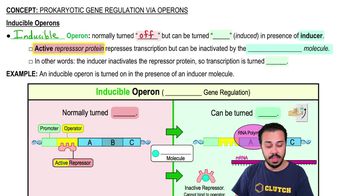
The lac operon is inducible with a default 'off' state; it is repressed when lactose is absent and activated when lactose is present and glucose is scarce.
What ligand binds the lac repressor and what effect does it have?
Allolactose binds the lac repressor, causing it to release the lac operator and allow transcription.
How does glucose availability affect lac operon activation?
Low glucose increases cAMP, which binds CRP; active CRP binds the promoter to enhance RNA polymerase binding and activate transcription.
What happens to lac operon expression when glucose is present and lactose is absent?
Expression is repressed because the lac repressor binds the operator and CRP is inactive due to low cAMP.
What is the effect of a mutation in the trp repressor that prevents tryptophan binding?
The repressor cannot bind tryptophan, so it remains inactive and the trp operon is constitutively expressed regardless of tryptophan levels.
What is the effect of a mutation in CRP that prevents cAMP binding?
CRP cannot activate the lac operon; transcription remains at basal levels even when lactose is present and glucose is absent.
List the 9 levels of gene expression control in eukaryotes.
1. Chromatin modification, 2. Transcription, 3. RNA processing, 4. Transport to cytoplasm, 5. mRNA degradation, 6. Translation, 7. Protein processing, 8. Protein degradation, 9. Protein transport.
How do eukaryotic transcription factors differ from prokaryotic ones?
Eukaryotic transcription factors bind to control elements like enhancers or silencers, not directly to promoters, and have separate DNA-binding and activation/repression domains.
What are enhancers and silencers in eukaryotic gene regulation?
Enhancers are cis-elements that bind activators to increase transcription; silencers bind repressors to decrease transcription, often acting at a distance from the promoter.
Why can different cell types express different genes despite having the same DNA?
Different cell types have distinct sets of transcription factors that bind specific control elements, leading to tissue-specific gene expression.
What is a reporter gene and how is it used in gene expression studies?
A reporter gene encodes an easily measurable product (e.g., GFP) and is fused to regulatory sequences to study gene expression patterns.
What molecular tools allow creation of recombinant DNA for reporter gene assays?
Restriction enzymes are used to cut and paste DNA fragments to create recombinant molecules for experimental analysis.
 뒤로
 04:25