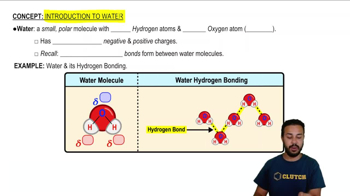
Water molecules are polar because electrons in the polar covalent bonds spend more time near oxygen than hydrogen, creating an unequal sharing of electrons.
How many hydrogen bonds can a single water molecule form?
Each water molecule can form hydrogen bonds with up to 4 other molecules.
Define cohesion in water.
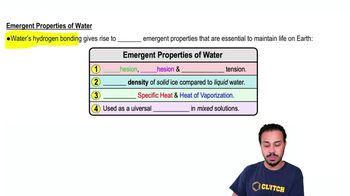
Cohesion is the ability of water molecules to cling together due to hydrogen bonding.
What is adhesion in the context of water?
Adhesion is the ability of water molecules to adhere to other surfaces.
Explain capillary action in plants.
Capillary action is the movement of water upward through narrow vessels in plants, driven by cohesion between water molecules and adhesion to vessel walls.
What is thermal energy?
Thermal energy is the kinetic energy associated with the random motion of atoms or molecules.
How is temperature different from thermal energy?
Temperature measures the average kinetic energy of molecules, while thermal energy is the total kinetic energy in a body of matter.
Define specific heat and its significance in water.
Specific heat is the heat required to raise 1 g of a substance by 1ºC; water has a high specific heat, allowing it to absorb heat with little temperature change.
Why does water have a high specific heat?
Water's high specific heat is due to hydrogen bonds that absorb heat when breaking and release heat when forming, stabilizing temperature.
What is heat of vaporization?
Heat of vaporization is the heat a liquid must absorb for 1 g to convert to gas; water has a high heat of vaporization due to hydrogen bonding.
Describe evaporative cooling.
Evaporative cooling occurs when the surface of a liquid cools as molecules with the highest kinetic energy evaporate.
Why does ice float on water?
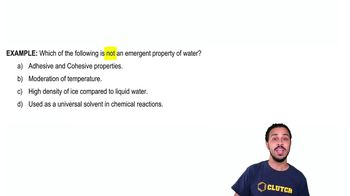
Ice floats because hydrogen bonds form a rigid, open lattice making ice less dense than liquid water.
What ecological role does floating ice play?
Floating ice insulates bodies of water, preventing them from freezing solid and allowing life to survive beneath.
What is a solution in biological terms?
A solution is a homogeneous mixture consisting of a solvent (most abundant) and one or more solutes dissolved in it.
Define hydrophilic and hydrophobic substances.
Hydrophilic substances dissolve readily in water (polar), while hydrophobic substances repel water and do not dissolve well (nonpolar).
What happens when salt (NaCl) dissolves in water?
Salt dissociates into Na+ and Cl- ions, which are surrounded by water molecules due to water's polarity.
What is the difference between an acid and a base?
Acids release H+ ions in solution; bases either take up H+ or release OH- ions.
How is pH related to hydrogen ion concentration?
pH is a logarithmic scale measuring H+ concentration; lower pH means higher H+ concentration (acidic), higher pH means lower H+ (basic).
What pH values indicate acidic, neutral, and basic solutions?
pH < 7 is acidic, pH = 7 is neutral, and pH > 7 is basic.
What role do buffers play in biological systems?
Buffers resist changes in pH by absorbing excess H+ or OH- ions, maintaining stable pH in body fluids.
Give an example of a biological buffer.
Carbonic acid (H2CO3) in blood buffers pH to about 7.4.
 뒤로
 01:54