Skip to main content
General Biology
나의 코스
배우기
시험 준비
AI 튜터
학습 가이드
교과서적 해결책
플래시카드
탐험해 보세요
앱을 사용해 보세요
나의 코스
배우기
시험 준비
AI 튜터
학습 가이드
교과서적 해결책
플래시카드
탐험해 보세요
앱을 사용해 보세요
뒤로
Proteins and Amino Acids - General Biology
카드를 뒤집기 위해 탭할 수 있습니다.
What are proteins made of?
카드를 뒤집기 위해 탭할 수 있습니다.
👆
What are proteins made of?
Proteins are made up of
amino acids
, which are the monomers of proteins.
진행 상황 추적
컨트롤 버튼이 '내비게이션' 모드로 변경되었습니다.
1/22
추천 영상
08:02
Protein Structure
25212
views
336
rank
04:37
Amino Acids
25890
views
452
rank
02:50
Proteins
31496
views
596
rank
1
comments
이 집합의 용어 (22)
하이드의 정의
What are proteins made of?
Proteins are made up of
amino acids
, which are the monomers of proteins.
How many different amino acids are there?
There are
20 different amino acids
that make up proteins.
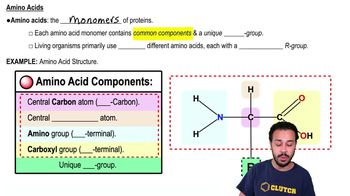
What are the three main parts of an amino acid?
An amino acid consists of an
amino group
, a
carboxyl group
, and an
R-group
attached to a central carbon.
What determines the difference between amino acids?
The
R-group
(side chain) varies among amino acids and determines their properties.
How are amino acids classified based on their R-groups?
Amino acids are classified as
polar (hydrophilic)
or
nonpolar (hydrophobic)
depending on their R-groups.
What makes an amino acid nonpolar?
If the R-group contains only
H or H + C
, the amino acid is
nonpolar (hydrophobic)
.
Give examples of nonpolar amino acids.
Examples include
glycine
,
alanine
, and
leucine
.
What makes an amino acid acidic?
Amino acids with a
carboxyl group (-COOH)
in their R-group are
acidic
, e.g., aspartic acid and glutamic acid.
What makes an amino acid basic?
Amino acids with an
amino group (-NH2)
in their R-group are
basic
, e.g., lysine.
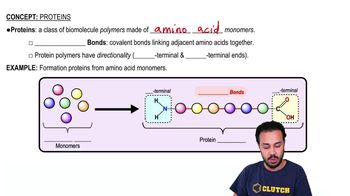
What is a polymer and a monomer in the context of proteins?
Monomers
are building blocks (amino acids), and
polymers
are many monomers linked together (proteins).
How are amino acids linked to form proteins?
Amino acids are linked by
peptide bonds
formed through
dehydration synthesis
reactions.
What is dehydration synthesis in protein formation?
It is the process where two amino acids lose a water molecule to form a
peptide bond
and create a dipeptide.
What is hydrolysis in the context of proteins?
Hydrolysis is the reverse reaction where water breaks peptide bonds, separating amino acids.
What is a dipeptide, tripeptide, and polypeptide?
A
dipeptide
has 2 amino acids, a
tripeptide
has 3, and a
polypeptide
has many amino acids linked.
Why is the order of amino acids important in peptides?
The sequence determines the peptide's identity and function; e.g., tyrosine-valine differs from valine-tyrosine.
Which amino acid has the simplest R-group?
Glycine
has the simplest R-group, which is just a hydrogen atom (H).
What is the R-group of alanine?
Alanine's R-group is a
methyl group (CH3)
.
What is the R-group of serine?
Serine's R-group contains a
hydroxymethyl group (CH2OH)
.
What is the R-group of aspartic acid?
Aspartic acid's R-group is
CH2COOH
, which makes it acidic.
What is the R-group of leucine?
Leucine's R-group is
CH2-CH-(CH3)2
, a branched nonpolar side chain.
What is the R-group of lysine?
Lysine's R-group is
CH2CH2CH2CH2NH2
, making it basic.
What is the relationship between DNA, mRNA, and proteins?
DNA is transcribed into
mRNA
, which is then translated into
proteins
.
 뒤로뒤로
 08:02